
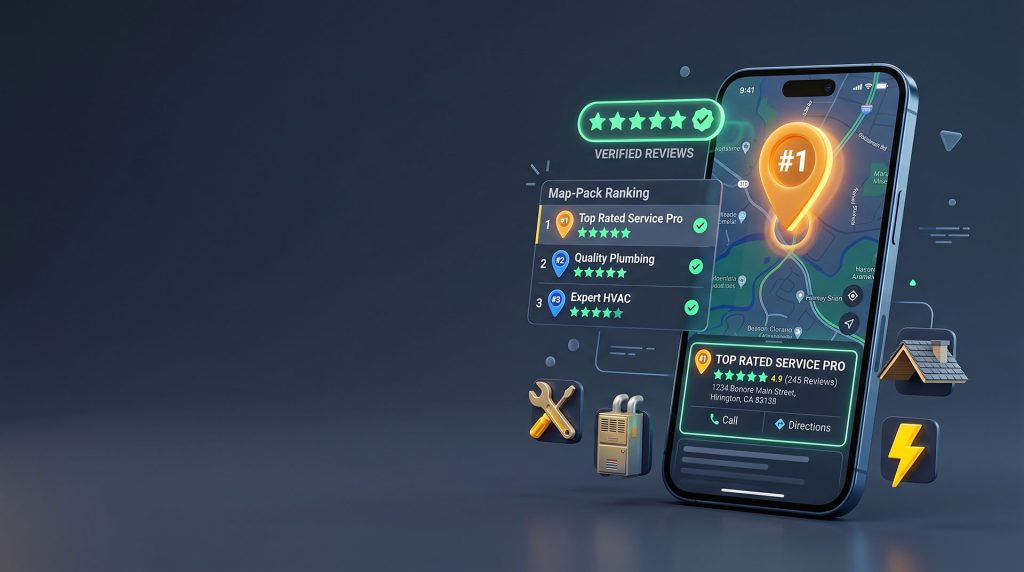
A complete, no-fluff playbook for HVAC companies, plumbers, roofers, electricians, landscapers, pest control operators, cleaning services, and contractors who want to stop renting leads and start owning their local market.
You Don’t Have a Lead Problem — You Have a Visibility Problem
Most service business owners think they have a lead problem. They don’t. They have a visibility problem stacked on top of a leak problem.
Here’s what we mean.
Right now, today, dozens of homeowners in your service area are typing “emergency plumber near me,” “AC repair [your city],” or “roof leak repair” into Google.
Some of them have a burst pipe flooding their basement. Some of them have a furnace that died on the coldest night of the year. These are not tire-kickers. They are ready to call someone in the next ten minutes and hand over a credit card.
The only question is: do they see you, or do they see your competitor?
If your business isn’t showing up in the Google Map Pack (the three businesses that appear with the little map at the top of local search results), you are invisible to the exact people most likely to become customers.
They will never know you exist. They will call the company ranked above you, that company will book the job, and you’ll never see a single dollar of that revenue.
That lead didn’t “not exist.” It existed, it was high-intent, and it leaked straight to your competitor before you ever had a chance.
Local SEO is how you plug that leak at the source. It’s how you make sure that when someone in your area needs exactly what you do, your name is the first they see, the first they trust, and the first they call.
This guide is long on purpose. Local SEO isn’t a single trick — it’s a system of interlocking pieces that compound on each other.
We’re going to walk through every one of those pieces, in order, with real examples from HVAC, plumbing, roofing, and electrical companies, plus actionable steps, checklists, tool recommendations, and a 90-day plan you can start executing tomorrow.
Let’s plug the leaks.
Want to see how much revenue your business is leaking right now? Before you read further, it’s worth quantifying the gap. Our trade-specific Lead Leak Calculators show you in about 60 seconds how many leads and dollars are slipping away each month from slow follow-up and weak online visibility.
What Local SEO Is and Why It Matters
Local SEO (search engine optimization) is the practice of optimizing your online presence so your business appears prominently when people search for services in a specific geographic area. When someone searches “drain cleaning Tampa” or “electrician near me,” local SEO determines whether you show up — and where.
It’s different from traditional SEO in one critical way: geography is the deciding factor. A national e-commerce store competes for rankings across the entire country. A roofing company in Charlotte only cares about ranking in Charlotte and the surrounding suburbs.
That narrowing of focus is actually good news for you, because it means you’re competing against a handful of local rivals, not the entire internet.
Why local SEO matters more for service businesses than almost any other type of business
Service businesses live and die by local demand. You can’t ship an HVAC repair to a customer in another state. Your entire customer base lives within a 30- to 60-minute drive of your shop. That makes local search the single most important marketing channel you have.
Consider what’s actually happening when someone searches:
- The intent is immediate and high. Nobody searches “emergency electrician” for fun. People searching for service businesses are usually in a moment of need — something broke, something is leaking, something stopped working — and they intend to hire someone soon. These are bottom-of-funnel buyers.
- “Near me” searches are exploding. Searches containing “near me” or “close by” have grown dramatically year over year, and the overwhelming majority of those searchers contact a business within 24 hours. A huge share of those people visit or call the same day.
- Mobile dominates. Most local searches happen on phones, often while someone is standing in their flooded kitchen or staring at a sparking outlet. They want a phone number and a “Call” button, not a 2,000-word essay.
- The map pack captures the clicks. The three businesses in the Google Map Pack soak up the lion’s share of clicks for local queries. If you’re not in those three spots, you’re fighting over scraps.
The economics: why one map pack ranking can be worth six figures
Let’s make this concrete with the kind of math we use in every [trade-specific lead calculator](https://groxpertise.com/lp/plumbing-lead-leak-calculator/).
Say you’re an HVAC company. Your average job ticket is $5,000 and you close about 28% of qualified leads. If ranking in the map pack brings you just 15 additional qualified calls per month, that’s roughly 4 closed jobs, or about $20,000 in new monthly revenue — $240,000 a year — from a channel that, once established, costs you almost nothing per lead.
For a plumber (average ticket ~$1,500, close rate ~20%), 30 extra calls a month means 6 jobs, around $9,000 monthly. For a roofer ($10,000 ticket, ~14% close), even a handful of extra leads can mean a six-figure swing. For an electrician ($1,500 ticket, ~22% close), the math compounds the same way.
The point is this: local SEO is not a “nice to have” line item. It is, for most service businesses, the highest-ROI marketing investment available, because it captures demand that already exists and intercepts it before your competitors do.
How Google Local Search Works
To win at local SEO, you have to understand what you’re actually competing in. When someone runs a local search, Google doesn’t return one set of results — it returns several distinct layers, and you need to be present in as many as possible.

The anatomy of a local search results page
- Paid ads (Google Ads / search ads). These appear at the very top, marked “Sponsored.” You pay per click. Local SEO doesn’t get you here, but understanding that these exist matters because they push organic results down.
- The Local Service Ads (the Google Guaranteed badge). Important note for our audience: These pay-per-lead ads with the green checkmark are designed for businesses serving homeowners and consumers.
Because GroXpertise works with businesses targeting contractor-owners (B2B), Local Service Ads usually don’t apply — but if your service business sells directly to homeowners, they’re worth knowing about.
- The Map Pack (also called the Local Pack or 3-Pack). This is the holy grail: a map with three business listings showing star ratings, review counts, hours, and a “Directions” or “Call” button. This is what local SEO is primarily fighting to win.
- Organic (“blue link”) results. Below the map pack are the traditional ten organic results. Your website’s pages — your service area pages, city pages, and blog content — compete here. Strong organic rankings reinforce your map pack presence and capture searchers who scroll past the map.
- Google Maps itself. Many people skip the web entirely and search directly inside the Google Maps app. Your Google Business Profile is what surfaces here.
Two separate but connected ranking systems
Here’s the mental model that clears up most confusion. Google runs two related ranking algorithms for local queries:
- One ranks your Google Business Profile in the Map Pack and Google Maps.
- One ranks your website pages in the organic blue-link results.
They’re separate systems with overlapping signals. Your Google Business Profile drives the map pack. Your website drives organic results. Both feed each other; a strong website boosts your profile, and a strong profile sends trust signals back to your site.
To dominate, you optimize both in parallel. That’s the throughline of this entire guide.
Understanding Google’s Local Ranking Factors
Google has publicly stated that local ranking comes down to three core pillars. Everything else you do serves one of these three. Memorize them:
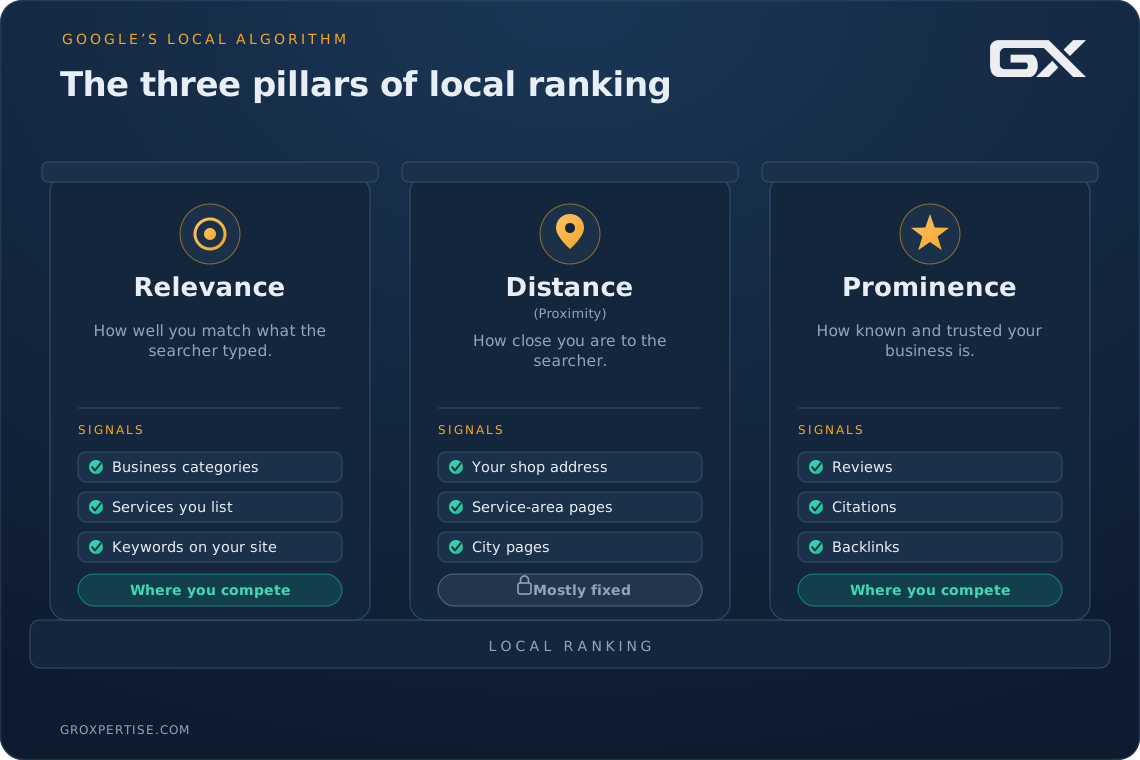
1. Relevance
How well does your business match what the searcher is looking for? If someone searches “tankless water heater installation” and your profile and website clearly mention tankless water heater installation as a service, you’re relevant. If your profile just says “plumber,” you’re less relevant for that specific query. Relevance is driven by your business category selections, the services you list, the keywords on your website, and the language in your reviews.
2. Distance (Proximity)
How close is your business to the searcher (or to the location term they used)? Proximity is one of the strongest factors in the map pack — and one you can’t directly control, since you can’t move your shop. But you can influence it indirectly through service area pages and city pages (more on those below), and by getting your address and service areas configured correctly.
3. Prominence
How well-known, trusted, and established is your business? Prominence is the factor you have the most long-term control over. It’s built through:
- Review quantity, quality, and recency — more reviews, higher ratings, and a steady, fresh stream.
- Citations — consistent mentions of your business across the web (directories, listings).
- Backlinks — other reputable websites linking to yours.
- Engagement signals — clicks, calls, direction requests, and website visits from your profile.
- Overall web presence — articles, your own website’s authority, social signals.
If you remember nothing else from this section, remember this: you compete on relevance and prominence, because distance is mostly fixed. Every tactic in this guide is designed to maximize relevance and prominence so that you out-rank competitors who are equally close to the searcher, or even closer.
Google Business Profile Optimization
Your Google Business Profile (GBP) — formerly Google My Business — is the single most important asset in local SEO. It is the engine of the map pack. If you do nothing else from this guide, do this. A fully optimized profile routinely out-ranks a half-finished one even when the half-finished business is older and closer.
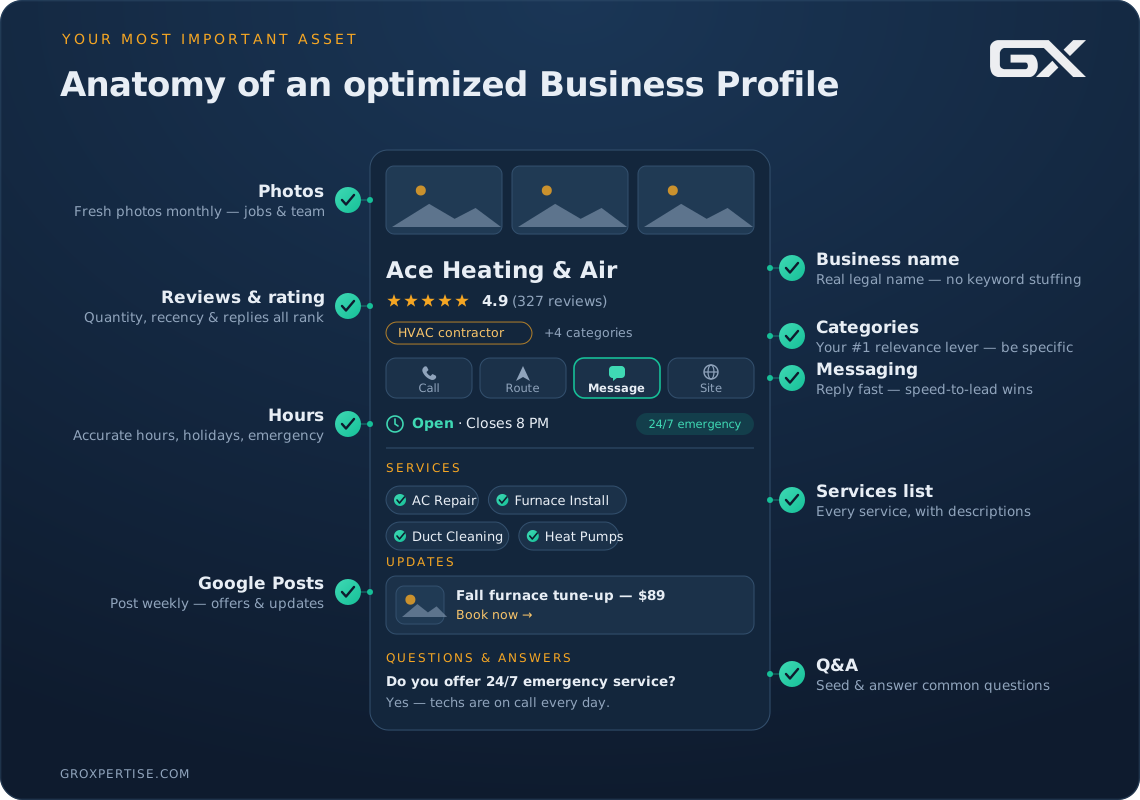
Claim and verify your profile
If you haven’t claimed your profile, go to google.com/business and claim it. Verification is usually by postcard, phone, email, or video. Don’t skip this — an unverified or unclaimed profile can’t be fully optimized and is vulnerable to hijacking.
Complete every single field
Google rewards completeness. Profiles with all fields filled out get significantly more views and actions. Fill in:
- Business name — your real, legal business name exactly as it appears on your signage and legal documents. Do not stuff keywords (e.g., “Joe’s Plumbing – Best Emergency Plumber Tampa”) — this violates Google’s guidelines and can get you suspended. Use “Joe’s Plumbing.”
- Primary category — choose the most specific category that fits (e.g., “HVAC Contractor,” “Plumber,” “Roofing Contractor,” “Electrician,” “Pest Control Service,” “Landscaper,” “House Cleaning Service”). This is one of your strongest relevance levers.
- Secondary categories — add all that apply. An HVAC company might add “Furnace Repair Service,” “Air Conditioning Repair Service,” and “Heating Contractor.”
- Phone number — a local number, ideally, matching your website exactly.
- Website — link to the most relevant page (often your homepage, or a specific service/city page).
- Hours — accurate, including special and holiday hours. If you offer 24/7 emergency service, set it.
- Service area — list every city, neighborhood, and ZIP you serve. This directly supports proximity to nearby towns.
- Services & products — list out every service with descriptions. This is hugely underused. Add “Furnace Replacement,” “Heat Pump Installation,” “Duct Cleaning,” etc., each with a short keyword-rich description.
- Business description — 750 characters. Write naturally, but work in your top services and service area.
- Attributes — “Veteran-owned,” “Online estimates,” “Emergency service,” etc.
Categories: the most powerful and most overlooked setting
Your primary category carries enormous weight. Choosing “Contractor” when you should have chosen “Roofing Contractor” can quietly cost you rankings for every roofing query. Research what categories your top-ranking competitors use (tools like GMBspy or PlePer can reveal this) and match or beat them.
Trade examples:
- HVAC: Primary “HVAC Contractor”; secondaries “Air Conditioning Contractor,” “Furnace Repair Service,” “Heating Contractor.”
- Plumbing: Primary “Plumber”; secondaries “Drainage Service,” “Water Heater Supplier,” “Hot Water System Supplier.”
- Roofing: Primary “Roofing Contractor”; secondaries “Gutter Cleaning Service,” “Roofing Supply Store” (only if applicable).
- Electrical: Primary “Electrician”; secondaries “Electrical Installation Service,” “Lighting Contractor,” “Generator Shop.”
Photos and videos
Profiles with photos get more clicks and direction requests. Upload high-quality images regularly: your team, your trucks, before-and-after job shots, your storefront, and equipment. Add new photos consistently — freshness is a signal. Roofers should show completed roofs; HVAC techs should show clean installs; plumbers should show before/after of a repipe; electricians should show panel upgrades.
Google Posts
Use the Posts feature like a mini social feed inside your profile. Post offers, updates, completed projects, and seasonal reminders (“Schedule your fall furnace tune-up”). Post, keep your profile active, and give Google fresh content. Aim for at least one per week.
Q&A
The Questions & Answers section is public, and you can seed it yourself. Add common questions (“Do you offer emergency service?” “Do you provide free estimates?”) and answer them with keyword-rich, helpful responses. Monitor it so competitors or trolls don’t answer on your behalf.
The Messaging and Booking features
Enable messaging so prospects can text you directly, and connect booking if you offer it. Faster response = more booked jobs. This is exactly the kind of leak our [trade checklists](https://groxpertise.com/lp/hvac-checklist/) are built to catch — a profile that generates inquiries you don’t answer fast enough is a profile that’s leaking money.
GBP optimization checklist
- Profile claimed and verified
- Legal business name (no keyword stuffing)
- Most specific primary category selected
- All relevant secondary categories added
- Local phone number matching website
- Accurate hours + holiday hours
- Complete service area (cities, ZIPs)
- All services listed with descriptions
- 750-character keyword-aware business description
- All relevant attributes set
- 20+ high-quality photos, updated monthly
- Weekly Google Posts scheduled
- Q&A seeded and monitored
- Messaging and/or booking enabled
Local Keyword Research
You can’t rank for searches you don’t know exist. Local keyword research is the process of mapping out exactly what your potential customers type into Google so you can build your profile, pages, and content around those phrases.
The three buckets of local service keywords
- Service + location keywords — the bread and butter. “Air conditioning repair Phoenix,” “emergency plumber Austin,” “roof replacement Denver,” “panel upgrade Sacramento.” These have high commercial intent.
- “Near me” keywords — “electrician near me,” “drain cleaning near me.” You can’t literally put “near me” on a page, but Google associates it with proximity, which your GBP and city pages serve.
- Problem/symptom keywords — “why is my AC blowing warm air,” “water heater leaking from bottom,” “circuit breaker keeps tripping,” “missing shingles after storm.” These are often top-of-funnel and great for blog content that builds prominence and captures earlier-stage searchers.
How to find your keywords
- Google autocomplete and “People also ask.” Start typing a service in Google and note the suggestions. Scroll to “People also ask” and “Related searches” at the bottom.
- Free tools: Google Keyword Planner (inside Google Ads), Google Trends, and AnswerThePublic for question-based queries.
- Paid tools: Ahrefs, Semrush, Moz, or the more affordable Ubersuggest and Keywords Everywhere. These give search volume and difficulty.
- Your own customers. Listen to how callers describe their problems. They use the exact language they typed into Google.
- Competitor analysis. Plug a top-ranking competitor’s site into Ahrefs/Semrush and see what they rank for.
Map keywords to intent and to pages
Organize keywords into a simple spreadsheet with columns for keyword, monthly volume, intent (emergency / research / comparison), and the page that should target it. This becomes your content roadmap.
Trade example — Plumbing
| Keyword | Intent | Target page |
|---|---|---|
| emergency plumber [city] | Emergency | City page |
| water heater installation [city] | Commercial | Service area page |
| Why is my water bill so high? | Research | Blog post |
| tankless vs tank water heater | Comparison | Blog post |
| sump pump replacement [city] | Commercial | Service page |
Build the high-intent, service+location keywords into your GBP and your service area/city pages first, because those convert fastest. Layer in research and comparison keywords throughout blog content over time to build authority and increase your map pack prominence.
Service Area Pages
A service area page is a dedicated page on your website that targets a specific service. This is foundational on-page SEO for any service business.
The mistake most contractors make is cramming all their services onto one “Services” page. That page can’t rank well for everything. Instead, give each major service its own page.
How to structure service area pages
Create one page per core service:
- HVAC: /services/ac-repair/, /services/furnace-installation/, /services/heat-pump-installation/, /services/duct-cleaning/
- Plumbing: /services/water-heater-installation/, /services/drain-cleaning/, /services/repiping/, /services/sump-pumps/
- Roofing: /services/roof-replacement/, /services/roof-repair/, /services/storm-damage/, /services/gutter-installation/
- Electrical: /services/panel-upgrades/, /services/ev-charger-installation/, /services/generator-installation/, /services/lighting/
What each service page should include
- A clear <h1> with the service and (where natural) your primary metro: “Furnace Installation in [City]”
- A description of the service, the problems it solves, and your process
- Why customers should choose you (licensing, warranties, financing, guarantees)
- Photos or before/after images
- Customer reviews specific to that service
- An FAQ section targeting question keywords
- A strong, repeated call-to-action (phone number, form, “Schedule Now”)
- Internal links to related services and relevant city pages
Service pages target the “what” (the service). City pages target the “where” (the location). Together, they cover your whole keyword map.
City Pages
If you serve multiple towns, city pages (sometimes called location pages) help you rank in towns where you don’t have a physical office. They target “service + that specific city” keywords and reinforce proximity signals.
The right way (and the wrong way) to build city pages
The wrong way is to spin up 50 near-identical pages where only the city name changes (“doorway pages”). Google penalizes this thin, duplicative content, and it can tank your whole site.
The right way is to make each city page genuinely useful and unique:
- Reference real local landmarks, neighborhoods, and ZIP codes
- Mention local context — climate (“Phoenix summers are brutal on AC compressors”), housing stock (“many older homes in this area have outdated panels”), local permitting nuances
- Include reviews and completed job examples from customers in that specific city
- Add photos of actual work done in that area
- Write unique copy — don’t template-swap. At minimum, the body should be substantially original per city.
- Include the city in the title tag, H1, URL, and naturally throughout
Prioritize, don’t blanket
Don’t build a city page for every tiny hamlet on day one. Start with your top 3–5 revenue cities, do them really well, prove the model, then expand. A handful of excellent city pages beats fifty thin ones every time.
Trade example — Roofing: A Dallas-Fort Worth roofer might build /roofing-plano-tx/, /roofing-frisco-tx/, and /roofing-mckinney-tx/, each referencing local storm history (hail is huge in North Texas), HOA requirements common in that suburb, and named neighborhoods, with photos of roofs they’ve actually replaced there.
On-Page Local SEO
On-page SEO is everything you control directly on your website pages. For local service businesses, the fundamentals are straightforward but frequently neglected.
Title tags and meta descriptions
- Title tag: ~60 characters, include the primary keyword and location. “AC Repair in Tampa, FL | Same-Day Service | [Brand]”
- Meta description: ~155 characters, compelling, with a call to action and a hint of urgency or value. It doesn’t directly affect rankings but drives click-through, which matters.
Headers (H1, H2, H3)
One H1 per page, containing the main keyword. Use H2 and H3 tags to structure content logically and incorporate secondary keywords (service variations, questions). This helps both readers and search engines.
URL structure
Keep URLs short, readable, and keyword-relevant: /services/water-heater-repair/ and /plumbing-austin-tx/. Avoid /page?id=4471.
Content quality and depth
Thin pages don’t rank. Aim for substantial, genuinely helpful content on every important page. Answer the questions customers actually have, address objections, and demonstrate expertise. Google increasingly rewards content that shows real experience and trustworthiness (often summarized as E-E-A-T: Experience, Expertise, Authoritativeness, Trustworthiness). Show your licenses, your team, your real jobs.
Images and alt text
Compress images so pages load fast. Use descriptive file names (furnace-installation-tampa.jpg) and alt text that describes the image and includes relevant keywords where natural.
Internal linking
Link your pages together logically: city pages to relevant service pages, blog posts to service pages, service pages to your contact page. Internal links spread ranking authority and guide visitors toward conversion. This is also where you connect your lead magnets — for example, linking from a service page to your [trade-specific Local Lead Checklist](https://groxpertise.com/lp/electrical-checklist/) or [Lead Leak Calculator](https://groxpertise.com/lp/roofing-lead-leak-calculator/) to capture visitors who aren’t ready to call yet.
Click-to-call and conversion elements
Every page should make it dead simple to contact you. A sticky header phone number (click-to-call on mobile), prominent forms, and clear CTAs. The best ranking in the world is wasted if the page doesn’t convert.
NAP Consistency
NAP stands for Name, Address, Phone number. NAP consistency means your business’s name, address, and phone number appear exactly the same everywhere they show up online — your website, your Google Business Profile, Yelp, Facebook, directories, everywhere.

Why it matters
Google cross-references your NAP across the web to confirm your business is legitimate and to understand where you’re located. Inconsistencies create confusion and erode trust (prominence). If your phone number is “(555) 123-4567” on your site, “555.123.4567” on Yelp, and an old number on a directory, Google can’t be sure these all refer to the same business — and that uncertainty can suppress your rankings.
What counts as an inconsistency
- Different phone numbers (including tracking numbers used inconsistently)
- “Street” vs “St.”, “Suite 200” vs “#200”, “Ste 200”
- Abbreviations and formatting differences
- Old addresses from when you moved
- Slight name variations (“Joe’s Plumbing” vs “Joe’s Plumbing LLC” vs “Joes Plumbing”)
How to fix it
- Decide on one canonical version of your NAP. Write it down exactly.
- Audit everywhere your business appears (your site, GBP, all directories, and social profiles).
- Update every instance to match the canonical version.
- Embed your NAP in your website footer and on your contact page in crawlable text (not just an image).
- Add LocalBusiness schema (covered below) with your exact NAP.
Tool tip: Moz Local, BrightLocal, Yext, or Semrush’s Listing Management can scan dozens of directories and flag inconsistencies automatically — a massive time-saver versus checking each by hand.
Local Citations
A citation is any online mention of your business’s NAP, with or without a link. Citations live in business directories, industry-specific listings, data aggregators, and local websites. They’re a core prominence signal: the more consistent, quality citations you have, the more Google trusts that your business is real and established.
Two types of citations
- Structured citations — listings in directories like Yelp, Yellow Pages, Angi, Bing Places, Apple Maps, BBB, Facebook, and Foursquare.
- Unstructured citations — mentions in blog posts, news articles, local sponsorship pages, etc.
Core directories every service business should be on
- Google Business Profile (the big one)
- Bing Places
- Apple Maps / Apple Business Connect
- Yelp
- Better Business Bureau
- Angi
- Yellow Pages
- Foursquare
- Nextdoor
Industry-specific and trade citations
Beyond the general directories, get listed in trade-relevant directories:
- HVAC/Plumbing/Electrical/Roofing: HomeAdvisor, Houzz, Thumbtack, Porch, BuildZoom, and trade association directories (ACCA, PHCC, NRCA, NECA).
- Local citations: your city’s chamber of commerce, local business associations, and community directories carry extra local weight.
How to build citations efficiently
You can build manually (more control, more time) or use an aggregator/service like BrightLocal Citation Builder, Yext, Moz Local, or Whitespark. Aggregators push your data to many directories simultaneously and keep them in sync.
Whichever route, consistency beats volume — 30 accurate, consistent citations outperform 200 sloppy, conflicting ones.
Online Reviews and Reputation Management
Reviews are arguably the second-most-powerful local ranking factor after your Google Business Profile itself — and they’re the single biggest driver of conversions.
A profile ranked #1 with a 3.4-star average and 11 reviews will lose calls to the #2 profile with a 4.9-star average and 340 reviews.
Reviews influence both rankings (prominence) and whether someone actually calls you.
What Google looks at
- Quantity — total number of reviews
- Average rating — your star average
- Recency — a steady stream of fresh reviews signals an active, trusted business; a wall of reviews from three years ago looks stale
- Velocity — the rate at which new reviews come in
- Keywords in reviews — when customers mention services and cities (“they replaced my water heater in Austin same day”), that reinforces relevance
- Your responses — Google rewards engagement; responding to reviews is a positive signal
How to get more reviews (the system that actually works)
- Ask every happy customer, every time. The number one reason businesses don’t have reviews is that they don’t ask. Build the ask into your job-completion process.
- Make it frictionless. Create your Google review short link (from your GBP) and text it to the customer the moment the job is done and they’re happy. A text link sent within an hour of completion converts far better than an email three days later.
- Train your techs. The person who did the work has the most influence. A simple “If you were happy with the service, it would mean a lot if you’d leave us a quick Google review — I’ll text you the link” works.
- Automate the follow-up. CRM and review tools (Podium, NiceJob, Birdeye, GatherUp) automatically request reviews after each job and route unhappy customers to private feedback first.
Responding to reviews
- Respond to every review, positive and negative.
- For positives, thank them and naturally mention the service/city (“Thanks for trusting us with your AC replacement in Mesa!”).
- For negatives, stay calm, professional, and solution-oriented. Never argue. A gracious response to a bad review often impresses future customers more than the review itself hurts you.
Don’t break the rules
Never buy fake reviews, never offer payment or discounts in exchange for reviews, and never review-gate in a way that violates Google’s policies. Getting caught can wipe your reviews or suspend your profile. The slow, honest way is the only durable way.
Reviews are a perfect example of the leak problem in action: every happy customer you don’t ask is a review that leaked away — and with it, the prominence and trust that would have brought you the next ten customers. A simple, consistent review-request system permanently plugs those leaks.

Local Link Building
Backlinks — links from other websites to yours — are a major prominence and authority signal. For local SEO, local and relevant links matter more than sheer quantity. A link from your town’s chamber of commerce or a local news site is worth more than a hundred spammy directory links.
Local link building tactics that work
- Local sponsorships. Sponsor a youth sports team, a charity 5K, or a community event. Many list and link sponsors on their websites. Bonus: real community goodwill.
- Chamber of commerce and local business associations. Membership usually includes a directory listing and link.
- Local news and PR. A genuinely newsworthy story — a free furnace giveaway for a family in need, a milestone, a community initiative — can earn coverage and links from local outlets.
- Supplier and manufacturer links. If you’re a certified dealer or installer (Carrier, Trane, GAF, Generac, etc.), many manufacturers have a “find a dealer” page that links to you.
- Partner and referral links. Cross-link with complementary, non-competing local businesses — a roofer with a gutter company, a plumber with a remodeler.
- Guest content and local blogs. Contribute expert articles to local or industry blogs.
- Scholarships and community resources. A small local scholarship can earn links from .edu and community sites (do this genuinely, not as a spam tactic).
- HARO / journalist requests. Provide expert quotes to journalists writing about home maintenance, storms, energy costs, etc.
Quality over quantity, always
Avoid link schemes, paid link networks, and mass-produced spam. One relevant, authoritative local link beats fifty junk links. Focus on links you’d want even if SEO didn’t exist — because those are the ones Google values.
Schema Markup
Schema markup (structured data) is code you add to your website that helps search engines understand your content. For local businesses, the right schema can enhance how you appear in search (rich results) and reinforce relevance.
The schema that matters for service businesses
- LocalBusiness schema (and its more specific subtypes like HVACBusiness, Plumber, RoofingContractor, Electrician) — tells Google your business name, address, phone, hours, service area, geo-coordinates, and price range. This is the most important one.
- Service schema — describes the specific services you offer.
- Review/AggregateRating schema — can display star ratings in results (follow Google’s guidelines carefully here, as policies on self-serving review markup change).
- FAQ schema — marks up your FAQ sections and can earn expanded listings.
- BreadcrumbList schema — clarifies your site structure.
How to implement it
- Use JSON-LD format (Google’s preferred method), placed in the page’s or body.
- On WordPress, plugins like Rank Math, Yoast, or Schema Pro can generate and manage schema without hand-coding.
- For a fully custom build, you can hand-write JSON-LD. Here’s a simplified LocalBusiness example structure (your developer can expand it):
{ "@context": "https://schema.org", "@type": "Plumber", "name": "Joe's Plumbing", "telephone": "+1-555-123-4567", "address": { "@type": "PostalAddress", "streetAddress": "123 Main St", "addressLocality": "Austin", "addressRegion": "TX", "postalCode": "78701" }, "areaServed": ["Austin", "Round Rock", "Cedar Park"], "openingHours": "Mo-Su 00:00-24:00", "url": "https://example.com" } - Validate your markup with Google’s Rich Results Test and Schema Markup Validator before and after deployment.
Schema won’t single-handedly skyrocket your rankings, but it removes ambiguity, supports your other signals, and can win you more eye-catching search listings — which means more clicks.
Mobile SEO
The majority of local and “near me” searches occur on mobile devices, often in urgent situations. If your website is slow, clunky, or hard to use on a phone, you lose the customer, no matter how well you rank. Google also uses mobile-first indexing — it primarily evaluates the mobile version of your site for rankings.
Mobile SEO essentials
- Responsive design. Your site must adapt cleanly to any screen size. Test on real phones.
- Page speed. Slow pages kill conversions and rankings. Compress images, minimize code, use caching, and a good host. Check Google PageSpeed Insights and aim to pass Core Web Vitals.
- Click-to-call buttons. Your phone number should be tappable. A sticky “Call Now” button on mobile is a conversion machine for emergency services.
- Easy forms. Short forms with large, finger-friendly fields. Don’t ask for ten fields when three will do.
- Readable text and tappable buttons. No pinching and zooming. Adequate spacing so people don’t fat-finger the wrong link.
- Fast-loading maps and directions. Make it effortless to find and reach you.
A homeowner standing in a flooded laundry room is not going to fight with a broken mobile menu. They’ll bounce and call your competitor. Mobile experience is lead generation.
Voice Search Optimization
More people search by voice every year — “Hey Google, find an electrician near me,” “Siri, who fixes water heaters in Denver.” Voice search tends to be conversational, question-based, and local. Optimizing for it overlaps heavily with good local SEO, with a few specific tweaks.
How to optimize for voice
- Target conversational, long-tail, question phrases. People speak differently than they type. “Where’s the closest 24-hour plumber” rather than “plumber 24h.” Build FAQ content around natural questions.
- Answer questions concisely. Voice assistants often read a single, direct answer. Provide clear, short answers near the top of relevant pages (this also helps you win featured snippets).
- Keep your GBP impeccable. Voice assistants pull heavily from Google Business Profile and directory data for hours, location, and “open now” answers. Accurate hours and NAP are essential.
- Local + “near me” intent. Most voice searches are local and high-intent. Your existing local SEO foundation does most of the heavy lifting.
- Fast, mobile-friendly site. Voice searches are overwhelmingly mobile, so everything in the mobile section applies doubly.
You don’t need a separate “voice SEO strategy.” You need solid local SEO, FAQ-style, conversational content, and a flawless Google Business Profile.
Tracking Rankings and Leads
If you can’t measure it, you can’t improve it — and you definitely can’t tell which efforts are paying off. Tracking separates businesses that compound their results from those that spin their wheels.
What to track
Rankings:
- Map pack rankings for your priority keywords (these vary by the searcher’s location, so use a tool that checks from specific geo-points).
- Organic rankings for your service and city pages.
- Tools: BrightLocal, Local Falcon (excellent for map-pack grid rankings), Semrush, Ahrefs, or Whitespark.
Visibility and engagement (from Google Business Profile Insights):
- Searches that found you (direct vs. discovery)
- Profile views
- Calls, direction requests, website clicks, and messages from your profile
Website performance (Google Analytics 4 + Google Search Console):
- Organic traffic by page
- Which queries you’re appearing for and your click-through rate (Search Console)
- Conversions: form fills, calls, chats
- Core Web Vitals and mobile usability
Leads and revenue (the part that actually pays the bills):
- Call tracking — use a call tracking tool (CallRail is the standard) to attribute phone calls to specific channels and pages. Important: use dynamic number insertion that preserves NAP consistency so tracking numbers don’t confuse Google.
- Form submissions and chat leads tagged by source
- Cost per lead by channel
- Close rate and revenue per lead — connect leads to booked jobs in your CRM so you know your true ROI
The metric that matters most
Rankings are a means, not the end. The end is booked, profitable jobs. Always tie your SEO reporting back to leads and revenue. A #1 ranking that produces no calls is a vanity metric; a #3 ranking that produces 40 calls a month is a win. Tracking the full path — impression → click → call → booked job → revenue — is exactly the kind of leak analysis our [Lead Leak Calculators](https://groxpertise.com/lp/hvac-lead-leak-calculator/) are designed to make visible.
Common Local SEO Mistakes
Avoiding these will put you ahead of most of your competitors, because most service businesses make several of them.
- Not claiming or under-optimizing the Google Business Profile. The single most common and most costly mistake. An incomplete profile leaves money on the table every day.
- Keyword-stuffing the business name. “Best Cheap Emergency Plumber Tampa LLC” violates guidelines and risks suspension. Use your real name.
- Inconsistent NAP across the web. Different phone numbers and address formats confuse Google and suppress rankings.
- Ignoring reviews — not asking for them, not responding to them, or (worse) buying fake ones.
- Thin or duplicate city pages. Cookie-cutter location pages with only the city name swapped get filtered or penalized.
- One bloated “Services” page instead of dedicated pages per service.
- Slow, non-mobile-friendly website. You rank, they tap, the page crawls, they leave.
- No tracking. Flying blind means you can’t tell what’s working or prove ROI.
- Wrong or too-broad GBP categories. “Contractor” instead of “Roofing Contractor” quietly costs you every targeted query.
- Set-it-and-forget-it. Local SEO isn’t a one-time project. Competitors keep working, Google keeps changing, and stale profiles lose ground. Consistency wins.
- Targeting homeowners with the wrong tactics when you serve businesses (or vice versa). Know your actual buyer. If you sell to contractor-owners (B2B), Local Service Ads and homeowner-focused directories won’t fit; your channel mix should reflect who actually writes the check.
- Capturing leads you don’t follow up on fast. The best SEO in the world is wasted if inquiries sit unanswered. Speed-to-lead is part of the system — and it’s the leak that quietly drains the most revenue.
The Complete Local SEO Checklist
Use this as your master reference. Work top to bottom.
Foundation
- Google Business Profile claimed and verified
- Profile 100% complete (name, categories, hours, services, description, attributes)
- Most specific primary category + all relevant secondaries
- Consistent NAP defined and documented
- NAP in crawlable text on website footer + contact page
- Mobile-responsive, fast-loading website (passes Core Web Vitals)
- Click-to-call enabled site-wide on mobile
Keywords & Pages
- Local keyword research completed and mapped to pages
- Dedicated service page for each core service
- City pages for top 3–5 priority cities (unique, locally relevant content)
- Optimized title tags, meta descriptions, and H1s on every key page
- Internal links connecting service pages, city pages, blog, and contact
- Compelling CTAs and lead-capture on every page
Authority & Trust
- Listed and consistent on core directories (Bing, Apple, Yelp, Facebook, etc.)
- Listed in industry/trade directories
- Local citations audited for consistency (Moz Local / BrightLocal)
- Review-request system in place (text link at job completion)
- Responding to all reviews, positive and negative
- Local link building underway (sponsorships, chamber, manufacturers, PR)
Technical
- LocalBusiness schema implemented and validated
- Service, FAQ, and review schema where appropriate
- Google Posts published weekly
- Photos updated monthly
- Q&A seeded and monitored
Measurement
- Google Analytics 4 + Search Console installed
- Call tracking set up (NAP-safe)
- Rank tracking for priority keywords (Local Falcon / BrightLocal)
- Monthly reporting tied to leads and revenue, not just rankings
The 90-Day Local SEO Implementation Plan
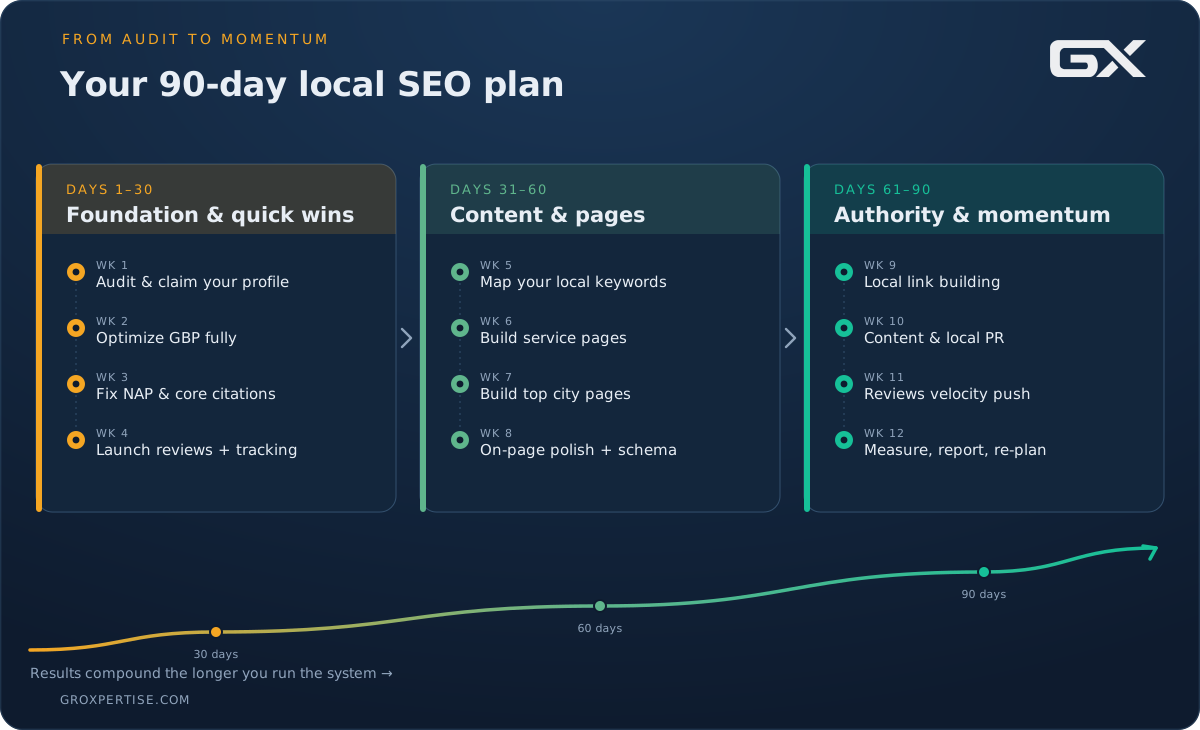
You can’t do everything at once, and you shouldn’t try. Here’s a realistic, sequenced 90-day plan that front-loads the highest-impact work. Each phase builds on the last.
Days 1–30: Foundation and Quick Wins
The goal this month is to fix what’s broken and claim the easy gains.
- Week 1 — Audit and claim. Claim/verify your Google Business Profile if you haven’t. Document your canonical NAP. Audit your current rankings, profile completeness, and citation consistency (run a BrightLocal or Moz Local scan).
- Week 2 — Optimize the profile. Complete every GBP field. Fix your primary and secondary categories. Add all services with descriptions. Write your business description. Upload 20+ photos. Enable messaging.
- Week 3 — Fix NAP and core citations. Correct your NAP everywhere it’s wrong, starting with the biggest directories (Bing, Apple, Yelp, Facebook, BBB). Add/clean your core directory listings.
- Week 4 — Launch your review engine. Get your Google review short link. Set up a simple system (even a saved text template) to ask every happy customer immediately after the job. Start responding to all existing reviews. Install Google Analytics 4, Search Console, and call tracking to measure from day one.
By the end of month one, your profile is fully optimized, your NAP is consistent, reviews are starting to flow, and you can measure everything.
Days 31–60: Content and Pages
The goal this month is to build the website assets that rank in organic results and reinforce your map pack.
- Week 5 — Keyword mapping. Finish your keyword research and map keywords to pages. Decide on your priority services and cities.
- Week 6 — Service pages. Build or upgrade a dedicated, in-depth page for each core service, fully optimized (title, H1, content, FAQ, CTAs, internal links).
- Week 7 — City pages. Create unique, locally rich city pages for your top 3–5 revenue cities. Reference real neighborhoods, local context, and city-specific reviews and photos.
- Week 8 — On-page polish and schema. Tighten title tags and meta descriptions across the site. Implement and validate LocalBusiness, Service, and FAQ schema. Set up internal linking. Keep publishing weekly Google Posts and adding photos.
By the end of month two, your website is a proper local-SEO machine: dedicated service and city pages, strong on-page optimization, and structured data, all reinforcing your profile.
Days 61–90: Authority and Momentum
The goal this month is to build prominence and lock in the habits that compound results.
- Week 9 — Local link building. Join your chamber of commerce. Reach out for links to the manufacturer/dealer. Identify a sponsorship or two. Start a partner cross-link or two with complementary local businesses.
- Week 10 — Content and PR. Publish 2–4 helpful blog posts targeting question/problem keywords. Pursue one local PR or community angle for coverage. Continue HARO/journalist responses.
- Week 11 — Reviews and engagement push. Double down on the review system — aim for a steady weekly velocity. Keep responding to everything. Refresh Q&A. Keep posting.
- Week 12 — Measure, report, and plan the next quarter. Review your rankings (Local Falcon grid), GBP insights, traffic, calls, and — most importantly — booked jobs and revenue. Identify what moved the needle. Set priorities for the next 90 days: more city pages, more content, more links, more reviews.
By the end of month three, you have a complete, measurable local SEO system and the habits to keep compounding it. Local SEO is a flywheel — the longer you turn it consistently, the harder it is for competitors to catch you.
Conclusion: From Leaking Leads to Owning Your Market
Local SEO isn’t magic, and it isn’t a one-time trick. It’s a system — Google Business Profile, keywords, pages, NAP, citations, reviews, links, schema, mobile, and measurement — where each piece reinforces the others. Done right, that system turns Google into a steady, low-cost source of high-intent leads who are ready to buy exactly what you sell, right now, in your own backyard.
But here’s the part most contractors miss: ranking is only half the battle. Every search you don’t show up for, every review you forget to ask for, every inquiry you don’t answer fast enough — those are leaks. And leaks are why most service businesses with “a lead problem” actually have plenty of leads slipping through the cracks. The businesses that win aren’t necessarily the ones with the biggest ad budgets. They’re the ones that plug the leaks: they show up, they get found, they get chosen, and they follow up fast.
That’s the entire premise on which GroXpertise is built. You probably don’t need more leads as much as you need to stop losing the ones you already generate.
Your next steps:
- Find out exactly how much you’re leaking. Run your trade’s free [Lead Leak Calculator](https://groxpertise.com/lp/hvac-lead-leak-calculator/) — [HVAC](https://groxpertise.com/lp/hvac-lead-leak-calculator/), [plumbing](https://groxpertise.com/lp/plumbing-lead-leak-calculator/), [roofing](https://groxpertise.com/lp/roofing-lead-leak-calculator/), or [electrical](https://groxpertise.com/lp/electrical-lead-leak-calculator/) — and get a personalized 3-move action plan in about a minute.
- Grab your trade’s Local Lead Checklist. Our 31-point [Local Lead Checklist](https://groxpertise.com/lp/hvac-checklist/) ([HVAC](https://groxpertise.com/lp/hvac-checklist/) · [plumbing](https://groxpertise.com/lp/plumbing-checklist/) · [roofing](https://groxpertise.com/lp/roofing-checklist/) · [electrical](https://groxpertise.com/lp/electrical-checklist/)) walks you through the exact local-presence essentials covered in this guide, step by step.
- Start with Days 1–30 above. Optimize your Google Business Profile this week. It’s the highest-leverage hour you’ll spend on your marketing all year.
Plug the leaks. Own your market. The demand is already out there — make sure it finds you first.
GroXpertise builds growth systems for home-service businesses — HVAC, plumbing, roofing, and electrical — that capture more of the leads you’re already generating. Because you don’t have a lead problem. You have a leak problem. Let’s fix it.