



A hailstorm rolls through town on Tuesday night. By Wednesday morning, hundreds of homeowners pick up their phones and type “roofer near me” or “roof repair” into Google.
Three roofing companies show up in the Map Pack. Those three get most of the calls. Everyone else fights over what’s left.
If your roofing company isn’t one of those three, you don’t have a lead problem. You have a leak problem.
The demand exists but leaks to the roofer down the road because Google and AI assistants like ChatGPT trust their business information more than yours.
This local SEO checklist for roofing companies shows you how to plug those leaks.
It covers 42 practical steps across seven phases: Google Business Profile, website, reviews, citations, content, AI visibility, and tracking. Each step explains what to do, why it matters, and mistakes to avoid.
It’s written for roofing company owners and managers, but HVAC, plumbing, and electrical contractors can use almost every step as is. We point out differences along the way.
Quick answer:
The most important local SEO steps for a roofing company are:
- choose “Roofing contractor” as your primary Google Business Profile category
- keep your business name, address, and phone number identical everywhere
- set up your service areas correctly
- build one strong web page per roofing service
- earn a steady flow of fresh Google reviews and respond to each
- list your business on trusted directories and manufacturer locators
- track calls to know which efforts produce booked inspections
Why Local SEO Is Different for Roofing Companies
Local SEO works the same way for every trade on paper. In practice, roofing has a few twists that make it harder, and more rewarding, than most.
High-ticket jobs mean high-trust decisions
A roof replacement is one of the largest checks a homeowner will ever write for home maintenance. People don’t pick a roofer the way they pick a pizza place.
They read reviews, look at photos, check for licenses and warranties, and compare two or three companies before they call.
That means ranking alone isn’t enough. Your Google Business Profile and website also have to earn the call once someone finds you.
Demand comes in waves
Roofing demand spikes after storms, hail, and high winds. When a storm hits, search volume jumps overnight.
Companies already ranking in the Map Pack capture that surge. Those not ranking can’t “catch up” in a week.
Local SEO is built before the storm, not during it.
Storm chasers muddy the water
Out-of-town crews often flood a market after major weather. Homeowners know this, and many are wary.
A strong local presence (a real local phone number, reviews from neighbors, photos of local jobs, and long-standing citations) is how you prove you’re the established local company, not a crew that will disappear in a month.
Most roofers are service-area businesses
Roofers work at customers’ homes, not at a storefront.
Google treats this kind of company as a service-area business, which comes with specific rules about hiding your address and defining service areas.
Get these wrong, and Google can suspend your profile or fail to rank it.
AI search is now part of the picture
According to BrightLocal’s Local Consumer Review Survey 2026, 45% of consumers now use AI tools like ChatGPT for local business recommendations, up from 6% the year before.
These tools pull information from your website, reviews, and directory listings across the web.
If your information is thin or inconsistent, AI assistants are less likely to recommend you.
For a broader view of how local search fits into your overall growth plan, see our roofing marketing guide.
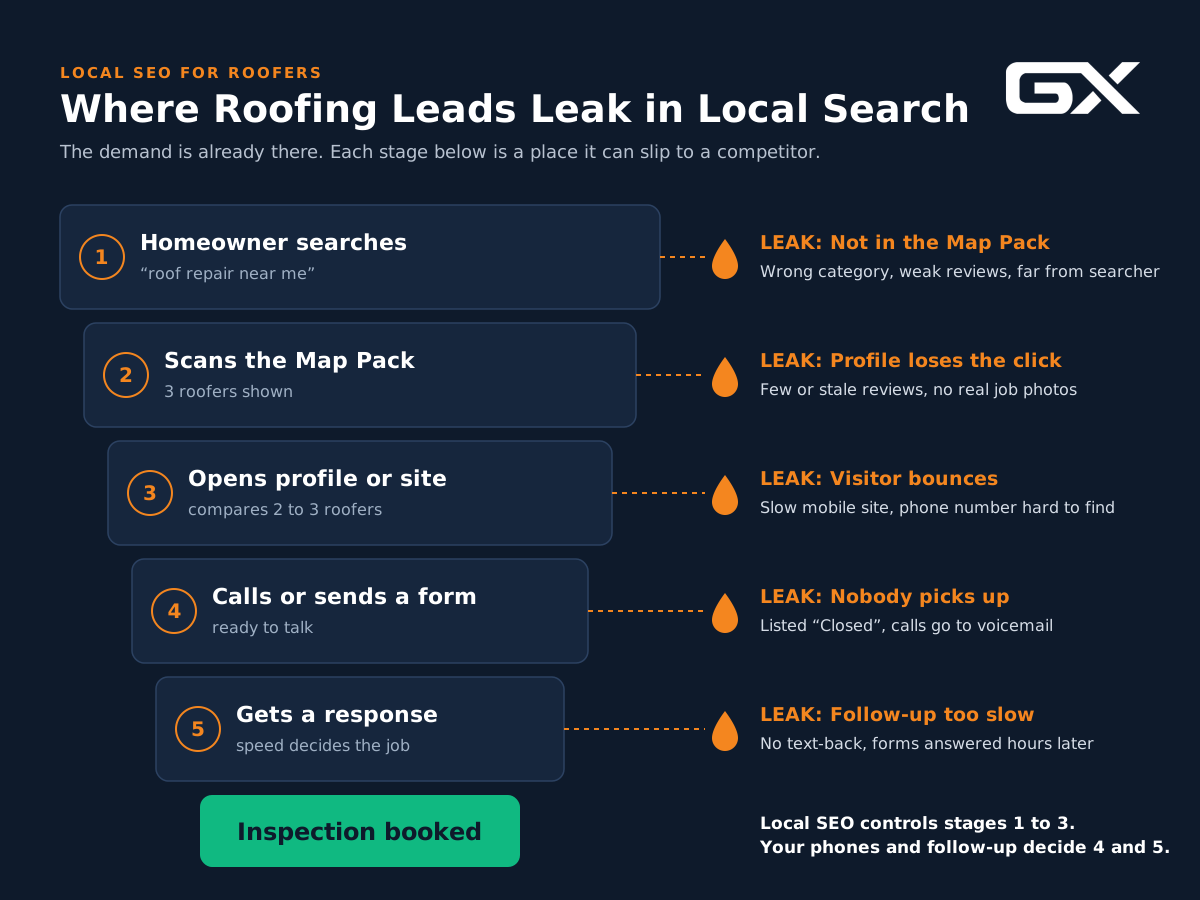
The Real Problem: Your Leads Are Leaking Before You Ever See Them
Most roofing owners measure marketing by one number: how many leads came in. That number hides where the money really goes.
Think about the path a homeowner takes:
- They search. “Roof leak repair near me.”
- They see the Map Pack. Three businesses appear. If you aren’t there, you’ve leaked the lead before it started.
- They click a profile. Weak photos, few reviews, or old reviews send them to the next listing.
- They call or fill out a form. A hard-to-find phone number or a clunky mobile site loses them.
- Someone answers. A missed call on a Saturday during storm season often means the homeowner calls the next roofer on the list.
- You book the inspection. Only now does the lead turn into revenue.
Local SEO controls steps 2 and 3 directly and strongly influences step 4.
Steps 5 and 6 involve your operations but decide whether all that SEO work pays off.
That’s why this checklist ends with tracking and call handling, not just rankings.
Want to see what these leaks may be costing you? Try the roofing lead leak calculator.
What Actually Moves Local Rankings in 2026
Before you start checking boxes, it helps to know which ones matter most.
Every year, Whitespark surveys leading local SEO experts for its Local Search Ranking Factors report.
The 2026 results estimate how much each group of signals influences Map Pack rankings:
| Signal group | Approx. influence on Map Pack rankings | Approx. influence on AI search visibility |
|---|---|---|
| Google Business Profile | ~25% | ~20% |
| Reviews | ~20% | ~18% |
| On-page (your website) | ~18% | ~22% |
| Links | ~15% | ~12% |
| Behavioral (clicks, calls, engagement) | ~12% | ~7% |
| Citations (directory listings) | ~5% | ~17% |
| Personalization | ~4% | ~2% |
| Social | ~1% | ~2% |
Source: Whitespark, Local Search Ranking Factors 2026. These are expert estimates, not Google-published weights.
The top individual factors for Map Pack rankings in the same report were:
- Primary Google Business Profile category
- Proximity of the business address to the searcher
- Keywords in the business name
- Physical address in the city being searched
- Business being open at the time of search
Two lessons stand out for roofers:
- Your Google Business Profile and reviews together drive almost half of Map Pack performance. Start there.
- Citations matter much more for AI visibility than for the Map Pack. If you’ve ignored directory listings because “they don’t move rankings anymore,” they’re back in play for ChatGPT and Google’s AI answers.

For the full breakdown of how these signals work across all trades, read our complete local SEO guide for service businesses.
The Local SEO Checklist for Roofing Companies (42 Steps)
The checklist is organized into seven phases. Work through them in order. Each phase builds on the previous one.
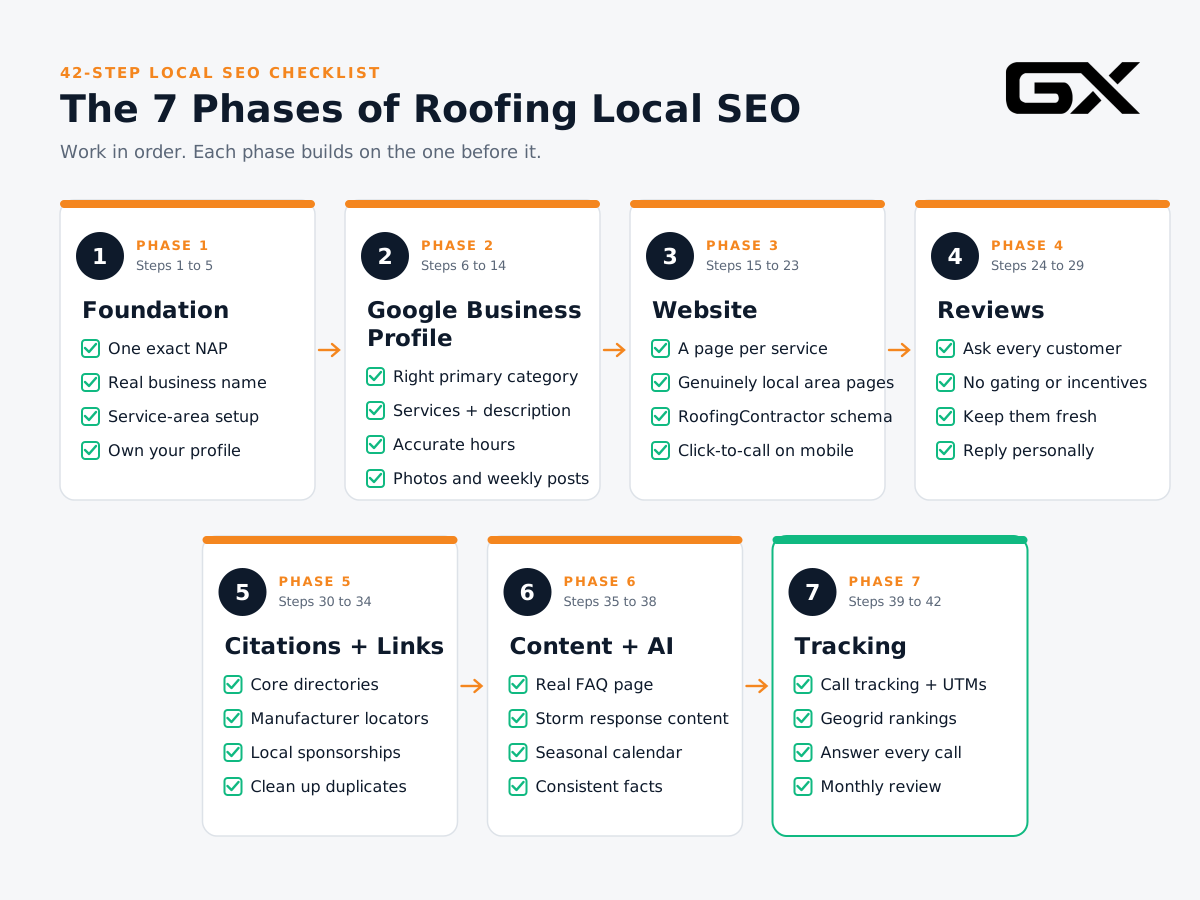
Prefer a printable version? Grab the printable roofing checklist.
Phase 1: Foundation (Steps 1 to 5)
Get these right first because every other step depends on them.
1. Lock in one exact version of your NAP
NAP stands for name, address, and phone number. Pick one exact format and use it everywhere: your website, Google, Facebook, Yelp, and all directories.
- Why: Google and AI tools cross-check your information across the web.
Mismatches (“Smith Roofing LLC” vs. “Smith Roofing & Exteriors,” or an old phone number) weaken trust.
- How: Write your official NAP in a shared document.
Include suite numbers and abbreviations exactly as you will use them (“Suite 200,” not sometimes “Ste. 200”).
- Common mistake: Using a different tracking number on every directory without a plan.
We cover the right way to handle call tracking in Phase 7.
2. Use your real business name (no keyword stuffing)
Whitespark ranks keywords in the business name as a top-three factor.
That’s exactly why so many roofers add “Best Roof Repair Denver” to their Google name.
Don’t do it. Google’s guidelines require your profile name to match your real-world business name.
Adding keywords often causes profile suspensions, and competitors can report you.
- The legitimate path: If your legal or branded name already includes “Roofing,” you get the benefit naturally.
If you’re rebranding anyway, consider a name that includes it, and update your signage, vehicles, and business registration to match.
3. Decide: storefront, service-area, or hybrid
Google’s service-area rules are clear: if you don’t serve customers at your business address, remove that address from your profile.
- Service-area business: You work at customers’ homes and don’t have staff welcoming customers at your office.
Hide the address.
- Hybrid business: You have a showroom or office where customers visit during posted hours (for example, to pick shingle colors).
Show the address and add service areas.
- Common mistake: Using a virtual office, P.O. box, or coworking desk as your address.
These violate Google’s guidelines and often lead to suspension.
4. Set your service areas correctly
Google allows up to 20 service areas.
Your overall area shouldn’t extend beyond about two hours of driving time from your base.
- How: List the cities, towns, or ZIP codes you actually serve. Start with the ones closest to your base.
- Set expectations: Service areas tell Google where you work. They don’t guarantee rankings in each area.
Proximity still matters, so you’ll rank most easily near your verified location.
Your website and reviews help you reach further (see Steps 16 and 24).
5. Verify your profile and control ownership
- Make sure the primary owner of your Google Business Profile is a company-controlled email, not a former office manager or an old marketing agency.
- Add team members and agencies as managers, not owners.
- Complete Google’s verification (video verification is common for service-area businesses).
Have your truck signage, tools, and business documents ready.
Why this matters: We regularly see roofers who can’t edit their own profile because an ex-employee or former vendor owns it.
Recovering access can take weeks.
Phase 2: Google Business Profile Optimization (Steps 6 to 14)
Your Google Business Profile is the single most influential local ranking asset you own.
Treat it like your best salesperson.
6. Choose “Roofing contractor” as your primary category
Primary category is the number one Map Pack factor in Whitespark’s 2026 report.
For almost every roofer, “Roofing contractor” is the right choice.
- Common mistake: Choosing “General contractor” or “Construction company” as primary because you also do siding or remodeling.
If roofing is your main revenue source, lead with it.
7. Add accurate secondary categories
Add secondary categories only for work you actually do and want calls for.
Depending on your services, these might include gutter, siding, skylight, or commercial roofing categories.
Browse Google’s category list for the exact names.
- Rule of thumb: Every category should match a real service with its own page on your website.
8. Fill out the Services section completely
List each service with a short, plain-language description:
- Roof replacement
- Roof repair and leak repair
- Storm, hail, and wind damage repair
- Roof inspections
- Insurance claim assistance (only if you actually help with claims)
- Metal roofing, tile, or flat and low-slope roofing (if offered)
- Commercial roofing (if offered)
- Gutters and ventilation (if offered)
Each description gives Google, and Google’s AI answers, more context about what you do.
9. Write a clear, helpful business description
You get 750 characters. Use them to explain:
- What you do (residential and commercial roofing, repair, replacement)
- Where you do it (your main city and surrounding areas)
- Why homeowners choose you (years in business, certifications, warranties, local crews)
Write for people first. Mention your services and main city naturally, then stop.
Avoid keyword lists, links, and promotions.
10. Keep hours accurate and answer the phone when you say you’re open
“Business is open at the time of search” is a top-five Map Pack factor.
If your profile shows you are closed on Saturday, you may be filtered out of Saturday searches.
- How: If you really answer calls on evenings and weekends (with an answering service or on-call team), reflect that in your hours.
- Common mistake: Listing 24/7 hours but sending calls to voicemail. You’ll rank for more searches but lose those leads at the phone.
- Storm tip: Use Google’s special hours feature to show extended availability after major weather.
11. Upload real, recent photos every month
Homeowners want to see your work. Upload:
- Before and after shots of completed jobs
- Crews on the job (with safety gear visible)
- Your branded trucks and trailers
- Close-ups of materials and details (flashing, ridge vents, drip edge)
- Your team and office
Skip stock photos and old “geotagging” tricks. Focus on real, recent, well-lit photos from local jobs.
12. Publish Google posts weekly
Posts show homeowners you are active. Rotate through:
- Recently completed projects (“New architectural shingle roof in [Neighborhood]”)
- Seasonal tips (“3 signs your roof took hail damage”)
- Storm updates (“We’re scheduling free inspections this week after Tuesday’s hail”)
- Offers (financing, free inspections)
13. Add attributes, booking links, and a tracked website link
- Add attributes that apply (for example, veteran-owned or women-owned, if true).
- Add a booking or appointment link if you use online scheduling.
- Add UTM tracking to your website link (for example, `?utm_source=google&utm_medium=organic&utm_campaign=gbp`) to see GBP traffic separately in Google Analytics.
14. Answer customer questions on your website, not just on Google
Google discontinued the Business Profile Q&A feature on November 3, 2025 and replaced it with AI-generated answers drawn from your website, profile, and reviews.
That means your website FAQ is now where you “answer” questions for Google.
If a homeowner asks Google’s AI “Does [Your Company] help with insurance claims?” the answer comes from what you have published. Build the FAQ page described in Step 35.
Phase 3: Website and On-Page SEO (Steps 15 to 23)
On-page signals are the largest factor group for AI visibility and the third largest for the Map Pack.
Your website also decides whether a visitor becomes a phone call. For the full website playbook, see our contractor website guide.
15. Build one dedicated page for each core service
Don’t cram every service onto one “Services” page. Create separate pages for:
- Roof replacement
- Roof repair
- Storm and hail damage
- Roof inspections
- Each roofing material you specialize in
- Commercial roofing (if offered)
Each page should explain the service, process, typical timelines, warranty coverage, and common questions.
Link each Google Business Profile category and service to its matching page.
16. Create service-area pages that are genuinely local
City pages can help you reach beyond your immediate area but only if they are useful. Google treats thin, copy-paste city pages (“Roofing in Town A,” “Roofing in Town B” with only the town name swapped) as low-quality doorway pages.
A strong service-area page includes:
- Real projects you’ve completed in that area (with photos)
- Reviews from customers in that area
- Local details that matter for roofs: common home styles, HOA rules, local permit requirements, and typical weather damage
- Directions or drive-time from your base
Start with your top five to eight areas. Add more only when you have real content.
17. Optimize title tags and headings
Every service and area page should have:
- A title tag with the service and location: “Roof Repair in [City], [State] | [Company Name]”
- One H1 that matches the page’s purpose
- Clear H2 subheadings that answer common questions
18. Show your NAP on every page
Put your business name, phone number, and (if not hidden) address in your site footer, exactly as it appears on Google.
Add a contact page with the same information and an embedded map of your service area.
19. Add RoofingContractor schema markup
Schema is code that helps search engines understand your business. Schema.org has a specific RoofingContractor type. Include:
- Business name, logo, phone, and URL
- Address (or service area)
- Hours
- Links to your Google, Facebook, and other profiles (the `sameAs` property)
- FAQ schema on your FAQ page
Test your markup with Google’s Rich Results Test before and after publishing.
20. Make your site fast on mobile
Most roofing searches, especially after storms, happen on phones. A slow site loses visitors before they see your phone number.
- Compress images (project photos are often the biggest culprit)
- Use quality hosting
- Check your Core Web Vitals in Google Search Console
21. Put click-to-call and a short form above the fold
On mobile, your phone number should be a tap-to-call button visible without scrolling.
Keep forms short: name, phone, address, and “What’s going on with your roof?”
Each extra field costs you leads.
Our conversion rate optimization guide covers page layouts that turn visitors into calls.
22. Display trust signals prominently
Roofing buyers want proof. Show:
- License and insurance information
- Manufacturer certifications (GAF, Owens Corning, CertainTeed, and so on, only if you hold them)
- Workmanship and manufacturer warranty details
- Years in business and number of local roofs completed (only if you can back it up)
- BBB accreditation or trade association memberships (such as NRCA or your state roofing association)
23. Publish a project gallery with local details
Create individual project pages or gallery entries: “Hail damage roof replacement in [Neighborhood], [City].”
Include before-and-after photos, materials used, and a job summary.
These pages build local relevance, give AI tools concrete examples, and help homeowners picture their own project.
Phase 4: Reviews and Reputation (Steps 24 to 29)
Reviews drive about 20% of Map Pack performance and heavily influence which roofer a homeowner calls.
The 2026 BrightLocal survey found 97% of consumers read reviews for local businesses and 68% require at least a 4-star rating before considering a business.
24. Build a review request system (not a “when we remember” habit)
- Send a text with your direct Google review link within 24 hours of job completion, while the customer is still excited about their new roof.
- Have the project manager or owner mention it in person during the final walkthrough.
- Send one polite reminder three to five days later if they haven’t left one.
Automation makes this consistent. Our business automation guide shows how to trigger review requests automatically from your CRM.
25. Never gate or pay for reviews
- Review gating means only asking happy customers for reviews, or screening customers before sending them to Google. Google prohibits it.
- Incentives (discounts, gift cards, or entries in a drawing for reviews) also violate Google’s policies.
Ask every customer. A few honest four-star reviews make five-star ones more believable.
26. Keep reviews fresh
Recency matters to homeowners.
BrightLocal found 74% of consumers look for reviews written within the last three months.
A roofer with 300 reviews but nothing new in six months can look less active than a competitor with 80 steady, recent reviews.
Goal: A steady flow every month, not a burst once a year.
27. Respond to every review, personally
According to BrightLocal, 80% of consumers are likely to use a business that responds to all reviews, and 50% are unlikely to choose a business that uses generic or templated replies.
- Thank the customer by name.
- Mention the specific job (“Glad the new metal roof held up great in last week’s storm”).
- Respond within a few days. Faster is better.
28. Handle negative reviews like a professional
- Respond calmly and briefly. Don’t argue in public.
- Acknowledge the concern, state what you’re doing about it, and invite them to call you directly.
- If a review clearly violates Google’s policies (a competitor, spam, or someone who was never a customer), flag it for removal.
Future customers read your response more closely than the complaint.
29. Build reviews beyond Google
Homeowners check an average of six review sites, according to BrightLocal. Apple Maps usage nearly doubled to 27% in the 2026 survey.
Build a presence on:
- BBB
- Apple Maps (through Apple Business Connect)
- Yelp, Angi, or Nextdoor, depending on what your local market uses
Phase 5: Citations and Links (Steps 30 to 34)
Citations (listings of your business on other sites) and links (other websites pointing to yours) build trust with Google and AI tools.
30. Claim your core citations
Start with the platforms that matter most:
- Apple Business Connect
- Bing Places for Business
- Yelp
- BBB
- Angi, HomeAdvisor, Nextdoor, and Houzz (as relevant)
- Your local chamber of commerce directory
Make sure every listing matches your NAP from Step 1 exactly.
31. Get listed on manufacturer contractor locators
If you hold a manufacturer certification (GAF, Owens Corning, CertainTeed, or others), confirm your listing on their “find a contractor” locator is complete and matches your NAP.
These trusted, industry-relevant listings are used directly by many homeowners.
32. Earn local links
Local links are some of the strongest signals you can build:
- Sponsor a Little League team, school event, or community charity
- Join your chamber of commerce and local business associations
- Ask suppliers and distributors to list you as a local installer
- Join trade associations (NRCA, your state roofing contractors association)
- Offer to answer roofing questions for local news stories after major storms
33. Clean up duplicates and outdated listings
Old addresses, previous business names, and duplicate listings confuse Google and AI tools.
Search your business name and old phone numbers to find stragglers, then update or remove them.
34. Do community work worth talking about
A roof donated to a veteran or family in need through a local nonprofit often earns local news coverage, links, social shares, and goodwill.
Do it because it is right; local visibility is a side benefit.
Phase 6: Content and AI Visibility (Steps 35 to 38)
Google’s AI answers and tools like ChatGPT pull from your website and from what the rest of the web says about you.
This phase ensures they have strong material to work with.
Our AI guide for service businesses goes deeper on how AI is changing the way homeowners find contractors.
35. Build a real FAQ page
Answer the questions homeowners actually ask your sales team:
- How much does a roof replacement cost in [City]? (Give honest ranges and explain what affects price.)
- Do you help with insurance claims?
- How long does a roof replacement take?
- What warranties do you offer?
- Should I repair or replace my roof?
- Do you offer financing?
Add FAQ schema (Step 19). This page now does the job Google’s old Q&A section used to do.
36. Publish helpful storm response content
After a major storm, publish a short, honest page or post:
- What damage to look for (and what’s safe to check from the ground)
- How to document damage for insurance
- How to spot out-of-town storm chasers
- How to book a free inspection with your local team
This content ranks when demand spikes and reinforces that you are the established local company.
37. Plan a seasonal content calendar
Roofing questions follow the seasons: ice dams and snow load in winter, spring inspections, summer heat and ventilation, fall prep before storm season.
Plan one helpful post or page per month matching what homeowners search for.
38. Keep your business facts consistent across the web
AI tools compare your information across many sources.
Whitespark’s 2026 data shows citations account for roughly 17% of AI search visibility, compared with about 5% for the Map Pack.
Make sure your services, service areas, hours, and credentials match across your website, GBP, Facebook, and directories.
Phase 7: Tracking and Plugging the Conversion Leak (Steps 39 to 42)
Rankings do not pay the bills. Booked inspections do. This phase connects your local SEO work to revenue.
39. Track calls from Google Business Profile
Use a call tracking tool to know which calls came from your profile, website, and ads.
- Best practice: Put the tracking number as the primary number on your Google profile and your main business number as an additional number. This keeps your NAP consistent while tracking results.
- Record calls (with proper disclosure) so you can review how leads are handled.
40. Monitor rankings with a geogrid tool
Checking your ranking by searching from your office shows only one spot.
Geogrid tools (such as Local Falcon or BrightLocal’s grid tracker) show your Map Pack position across a grid of points in your service area.
Track terms like:
- roofer near me
- roofing contractor
- roof repair
- roof replacement
- hail damage roof repair
Check monthly. Expect strong rankings near your base and weaker ones farther out.
41. Answer every call and respond to every form fast
This is where most roofing leads quietly leak. Even the best local SEO cannot help if calls go to voicemail.
- Use an answering service or on-call rotation for evenings and weekends, especially during storm season.
- Set up missed-call text-back so every missed caller gets an immediate text.
- Respond to web forms within minutes, not hours.
Our lead generation guide for service businesses explains how speed to lead affects booked jobs.
42. Review your numbers monthly
Once a month, look at:
- GBP views, calls, direction requests, and website clicks (in the Performance section)
- New reviews and average rating
- Geogrid rankings for your core terms
- Tracked calls and form submissions
- Booked inspections and signed jobs from local search
The last line matters most. If rankings go up but booked jobs do not, the leak is further down the funnel.
Examples: What This Looks Like in Practice
The examples below are illustrative composites based on common patterns we see in the roofing industry. They are not specific client case studies.
Example 1: The roofer who ranked at the shop and nowhere else
A three-crew residential roofer ranked in the top three for “roofer near me” within a few miles of their office.
Fifteen miles away, in the fastest-growing suburb in their market, they didn’t show up at all.
What was leaking:
- One generic “Service Areas” page listed 30 towns in a paragraph.
- Almost no reviews mentioned the suburb.
- No project photos from that area.
What they changed:
- Built one service-area page for the suburb featuring eight real projects, photos, and notes about the local HOA’s shingle color requirements.
- Asked recent customers in that suburb to mention their project in their review (without scripting what to say).
- Added GBP posts about completed jobs there.
Realistic outcome:
Over several months, visibility in that suburb typically improves for “roof replacement [suburb]” style searches first, then gradually for broader terms.
Proximity limits how far a single location can reach, so expectations should stay realistic.
Example 2: The storm season voicemail problem
A roofing company’s profile listed hours as 8 a.m. to 5 p.m., Monday through Friday.
After a Friday evening hailstorm, homeowners searched all weekend. The company’s profile showed “Closed,” and the few calls that came went to voicemail.
What they changed:
- Added an answering service for evenings and weekends.
- Updated hours to reflect real phone availability and used special hours after major storms.
- Turned on missed-call text-back.
- Published a storm response post the morning after each major event.
The lesson:
Hours and phone handling are local SEO.
Showing “Closed” and missing calls during the highest-demand hours is one of the costliest leaks a roofer can have.
Example 3: The suspended profile
A roofer added “Best Roof Repair & Replacement” to their Google Business Profile name. Rankings jumped for a few weeks.
Then a competitor reported the profile, and Google suspended it. Reinstatement took weeks, right in the middle of spring.
The lesson: Shortcuts that break Google’s guidelines create a single point of failure. Build rankings you can keep.
How other trades apply the same checklist
- HVAC: Primary category is usually “HVAC contractor” or a closely related option.
Hours matter even more during heat waves and cold snaps.
See our HVAC marketing guide.
- Plumbing: Emergency service drives huge volume, so after-hours answering and accurate hours are critical.
See our plumbing marketing guide.
- Electrical: Service pages for panel upgrades, EV charger installation, and generators often perform well.
See our electrical marketing guide.
Common Local SEO Mistakes Roofers Make
- Keyword stuffing the business name. It can work briefly, then lead to suspension.
- Using a virtual office or P.O. box as your address. Against Google’s guidelines and a common suspension trigger.
- Copy-paste city pages. Dozens of near-identical pages rarely rank and can drag down your site’s overall quality.
- Letting reviews go stale. A big review count with nothing recent sends the wrong signal.
- Generic review replies. “Thanks for the review!” on every response looks automated because it is.
- Inconsistent NAP. Old phone numbers and previous business names scattered across directories.
- Wrong primary category. “General contractor” instead of “Roofing contractor.”
- No tracking. Without call tracking and UTM tags, you can’t tell whether local SEO is paying off.
- Ranking without answering. Winning the Map Pack and then sending storm-season calls to voicemail.
- Letting an agency or ex-employee own your profile. Always keep primary ownership in a company account.
How to Implement This Checklist: A 90-Day Plan
You do not need to do all 42 steps this week. Here is a realistic rollout for a roofing company with limited time.
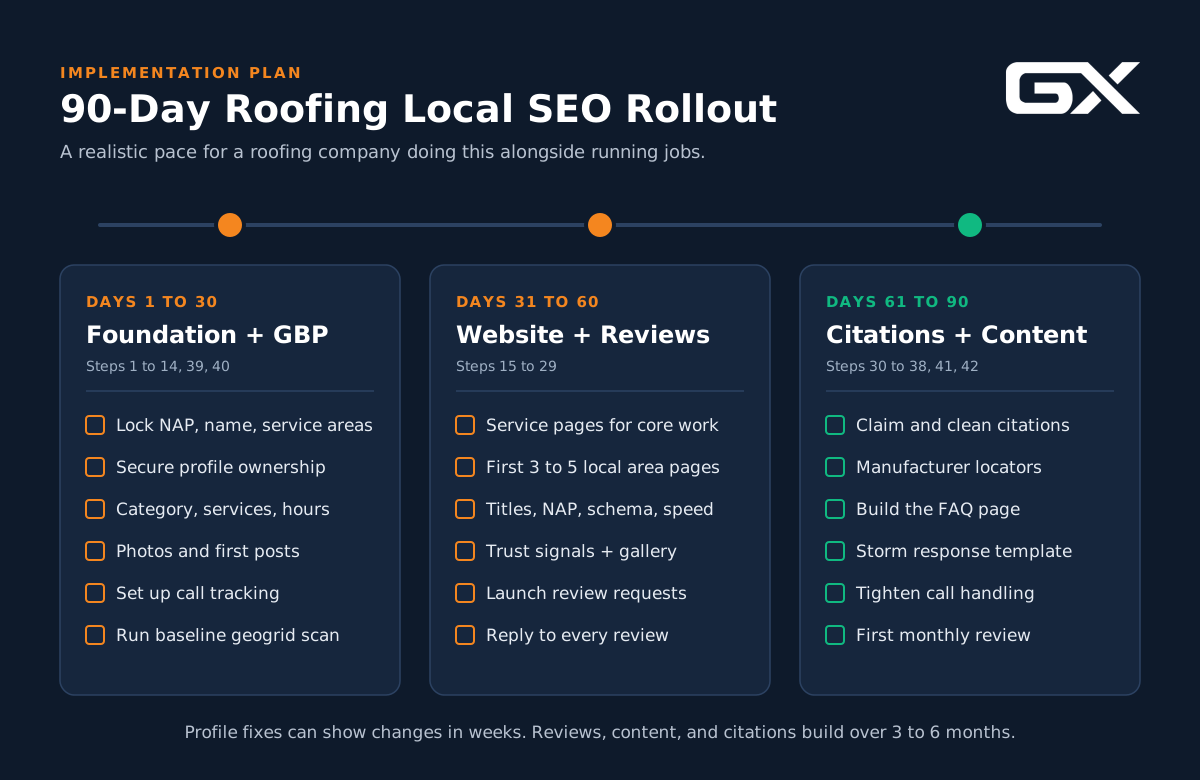
Days 1 to 30: Foundation and Google Business Profile
- Complete Steps 1 to 5 (NAP, name, address setup, service areas, ownership).
- Complete Steps 6 to 14 (categories, services, description, hours, photos, first posts, UTM link).
- Set up call tracking (Step 39), so you have a baseline.
- Run a baseline geogrid scan (Step 40).
Owner time: About 4 to 6 hours plus photo collection from your crews.
Days 31 to 60: Website and reviews
- Build or improve service pages (Step 15) and your first three to five service-area pages (Step 16).
- Fix title tags, NAP, schema, and mobile speed (Steps 17 to 21).
- Add trust signals and a project gallery (Steps 22 and 23).
- Launch your review request system (Steps 24 to 29).
Owner time: Depends on your website setup; content often takes the longest.
Days 61 to 90: Citations, content, and optimization
- Claim and clean up citations (Steps 30 to 33).
- Build your FAQ page and first seasonal content (Steps 35 and 37).
- Prepare a storm response page template (Step 36) so it’s ready when you need it.
- Tighten call handling (Step 41) and run your first full monthly review (Step 42).
What results to expect
Local SEO is not instant. Profile fixes like categories and hours can show changes within a few weeks.
Review growth, website improvements, and citations typically take three to six months.
Competitive metro markets take longer than smaller towns. Anyone who guarantees a number one ranking by a specific date is guessing.
Expert Tips for Roofing Local SEO
- Photograph every job. Make before and after photos a required step in your job close-out process.
They feed your GBP, website, project pages, and social media.
- Train your crews on reviews. The crew lead who shakes the homeowner’s hand at the end of the job is your best review asker.
- Prepare for storms in advance. Have a storm post template, special-hours plan, and answering service ready before the season starts.
- Match every GBP service to a web page. It creates a consistent story for Google and AI tools.
- Watch your competitors’ profiles. Note their categories, review velocity, and photo frequency.
You don’t need to copy them, but you should know what you’re up against.
- Tie SEO to revenue, not rankings. Report on booked inspections and signed jobs from local search every month.
If you also run paid search, coordinate it with local SEO so you do not pay for clicks you would win organically.
See our Google Ads for contractors guide.
Frequently Asked Questions
What is local SEO for roofing companies?
Local SEO for roofing companies is the process of improving your visibility in Google’s Map Pack, local search results, and AI-generated recommendations for searches like “roofer near me” or “roof repair [city].”
It includes optimizing your Google Business Profile, website, reviews, directory listings, and local content.
How long does local SEO take for a roofer?
Quick fixes like correcting your primary category, hours, and services can show changes in a few weeks.
Larger gains from reviews, website content, and citations usually build over three to six months.
Competitive markets and newer businesses often take longer.
Should my roofing company show its address on Google?
Only if customers visit your location during your posted hours.
Google’s guidelines say that if you don’t serve customers at your business address, you should remove it and set service areas instead.
Most residential roofers are service-area businesses and should hide their address.
How many service areas can I add to my Google Business Profile?
Google allows up to 20 service areas. Your overall service area shouldn’t extend beyond about two hours of driving time from your business’s base.
How many Google reviews does a roofing company need?
There is no magic number. What matters is how you compare with roofers ranking in your area and how recent your reviews are.
Aim for a steady flow every month, respond to all, and focus on beating your local competitors’ review count and freshness over time.
Can I rank in cities where I don’t have an office?
Yes, but it is harder.
Proximity is one of the strongest Map Pack factors, so you will rank most easily near your verified location.
Genuinely local service-area pages, reviews from customers in those areas, and project content can help you gain visibility in nearby cities, especially for more specific searches.
Do citations still matter for roofing local SEO?
Yes. Citations carry modest weight for Map Pack rankings, but Whitespark’s 2026 report estimates they account for roughly 17% of AI search visibility.
Consistent listings also help homeowners searching on Apple Maps, Bing, Yelp, and other platforms.
What happened to the Q&A section on Google Business Profile?
Google discontinued the Q&A feature on November 3, 2025.
Google replaced it with AI-generated answers based on your website, profile information, and reviews.
A thorough FAQ page on your website is now the best way to shape how those questions get answered.
Should I hire an agency or do local SEO myself?
Many roofing owners can complete the foundation and Google Business Profile steps themselves.
Website development, content, review automation, citation cleanup, and ongoing tracking take more time and expertise.
A good partner should show you exactly what they’re doing and report on booked jobs, not just rankings.
Conclusion: Plug the Leaks Before the Next Storm
Local SEO for roofing companies comes down to three jobs:
- Get found: a well-built Google Business Profile, strong service pages, and consistent citations.
- Get chosen: fresh reviews, real project photos, and clear trust signals.
- Get booked: fast answers, tracked calls, and a team ready when demand spikes.
Most roofers do not need more leads. They need to stop losing the ones already searching for them.
Work through this local SEO checklist for roofing companies one phase at a time, and you will build visibility you get to keep, storm season after storm season.
Get a Free Local SEO Audit for Your Roofing Company
Not sure which of these 42 steps your business is missing?
GroXpertise helps roofing, HVAC, plumbing, and electrical contractors find and fix the leaks between local search and booked jobs.
Our free Local SEO Audit reviews your Google Business Profile, website, reviews, citations, and Map Pack rankings across your service area, then shows you exactly where leads are leaking and what to fix first.
Get Your Free Local SEO Audit ?
Prefer to start on your own? Download the printable roofing checklist or estimate what missed calls are costing you with the roofing lead leak calculator.