

Most HVAC owners think they have a lead problem. They don’t. They have a leak problem.
You’re already getting leads — from your website, your Google listing, the ad you’re running, the customer who referred a neighbor. The trouble is how many of them quietly slip away before they ever become a booked job.
A call that rings out at 5:07 on a Friday. A form was filled out, but nobody answered until Monday. A homeowner who couldn’t find your reviews. A past customer who replaced their system with the company that remembered to follow up.
This guide is about plugging those leaks and building a growth system that turns the leads you already pay for into revenue — then turning up the volume on top of a foundation that actually holds water.
It’s written specifically for HVAC business owners, grounded in current 2025–2026 benchmark data, and organized so you can read it start to finish or jump to the section you need.
What’s in this guide
- The HVAC industry in 2026: the landscape you’re competing in
- The leak problem: why your real issue isn’t lead volume
- Building an HVAC growth system
- Local SEO for HVAC companies
- Google Business Profile optimization
- HVAC website optimization
- Google Ads for HVAC
- Local Services Ads (Google Guaranteed)
- HVAC content marketing
- HVAC review generation
- HVAC referral programs
- HVAC email and SMS marketing
- HVAC automation and speed-to-lead
- HVAC CRM systems
- Seasonal marketing strategies
- Retention strategies
- Revenue growth strategies
- Your HVAC marketing budget
- The 12-month growth roadmap
- Putting it all together
The HVAC industry in 2026: the landscape you’re competing in
Heating and cooling is one of the largest and most fragmented home-service markets in the country.
The U.S. HVAC services industry generates well over $35 billion a year (IBISWorld), spread across an estimated 114,000-plus companies.
Demand is durable — equipment ages, breaks, and gets replaced regardless of the economy — and the market is projected to keep growing at roughly a 7% annual clip through the end of the decade.
Durable demand is good news.
The catch is that the way homeowners find an HVAC company has changed, and most of the money now flows to whoever is most visible at the exact moment a system fails.
A few realities shape everything that follows:
- Most buyers have no loyalty when they start. Industry research consistently finds that around 84% of consumers don’t have a specific HVAC company in mind when they begin searching.
They search “AC repair near me,” scan the first few results and their star ratings, and call whoever looks trustworthy and answers.
The contractor who shows up first with strong reviews usually wins the job, not necessarily the best technician in town.
- The decision is fast and urgent. A homeowner with no heat in January or no cooling in July isn’t opening five tabs to comparison-shop. They’re calling the first credible option. Speed and visibility beat polish.
- The search results page is more crowded than ever. Local Services Ads with the “Google Guaranteed” badge sit at the very top, traditional search ads below them, the map pack below that, and organic listings below that.
On top of this, Google’s AI Overviews now appear on roughly half of tracked queries (BrightEdge, early 2026), pushing traditional links further down and changing how clicks flow.
Being on page one is no longer enough; you have to win specific positions.
The takeaway: HVAC is not a market where the best company automatically wins.
It’s a market where the most findable, fastest-responding, most trusted-looking company wins. That’s a marketing problem — and a solvable one.
The leak problem: why your real issue isn’t lead volume
Before we talk about generating more leads, look honestly at what happens to the ones you already get.

Picture every lead your business generates this month flowing into one pipe. At the far end, booked jobs come out. In most HVAC companies, far fewer come out than went in — and the difference isn’t bad luck.
It’s leaks:
- Slow follow-up. Speed-to-lead is the single most expensive leak in home services.
Research across industries shows that about 78% of customers hire the first company that responds, that responding within roughly a minute can dramatically lift conversion rates compared to waiting, and that waiting even five minutes sharply reduces the odds that a lead is still reachable and qualified.
Every minute your phone goes unanswered, or your web form sits in an inbox, the homeowner is calling the next name on the list.
- Invisibility on the map. Your Google Business Profile shows up in the overwhelming majority of local searches.
If it’s unclaimed, thin, or out-ranked, you’re invisible at the exact moment of need.
- A leaky website. More than half of mobile visitors abandon a page that takes longer than about three seconds to load (Google).
A slow site, a buried phone number, or a lack of a clear “book now” button leaks high-intent traffic you paid to attract.
- Thin or stale reviews. Around 87% of consumers read online reviews for local businesses before choosing one (BrightLocal).
A company with 250 recent reviews at 4.8 stars books more jobs than one with 20 reviews at 5.0 — volume and recency both matter.
- No nurture. A past HVAC customer is worth roughly $3,000 to $6,000 over their lifetime.
If you never follow up with tune-up reminders or seasonal offers, you’re leaking the cheapest, highest-margin revenue you’ll ever have.
Here’s the strategic point: plugging these leaks is cheaper and faster than buying more leads.
If you double your booked-job rate from the same lead volume, you’ve effectively cut your cost per acquired customer in half without spending another dollar on ads.
That’s why this guide front-loads the foundation before the volume.
Want to see what your specific leaks cost you? The HVAC Lead Leak Calculator estimates the revenue slipping through your follow-up, visibility, and conversion gaps in about two minutes.
Building an HVAC growth system
Marketing fails in HVAC companies for one repeatable reason: the pieces get bought separately and never connect.
A website here, an SEO contract there, a Google Ads account, a pile of business cards — each one running in isolation, none of them measured against booked jobs.
A growth system is different. It treats lead generation, conversion, delivery, and retention as one connected loop, where each stage feeds the next.
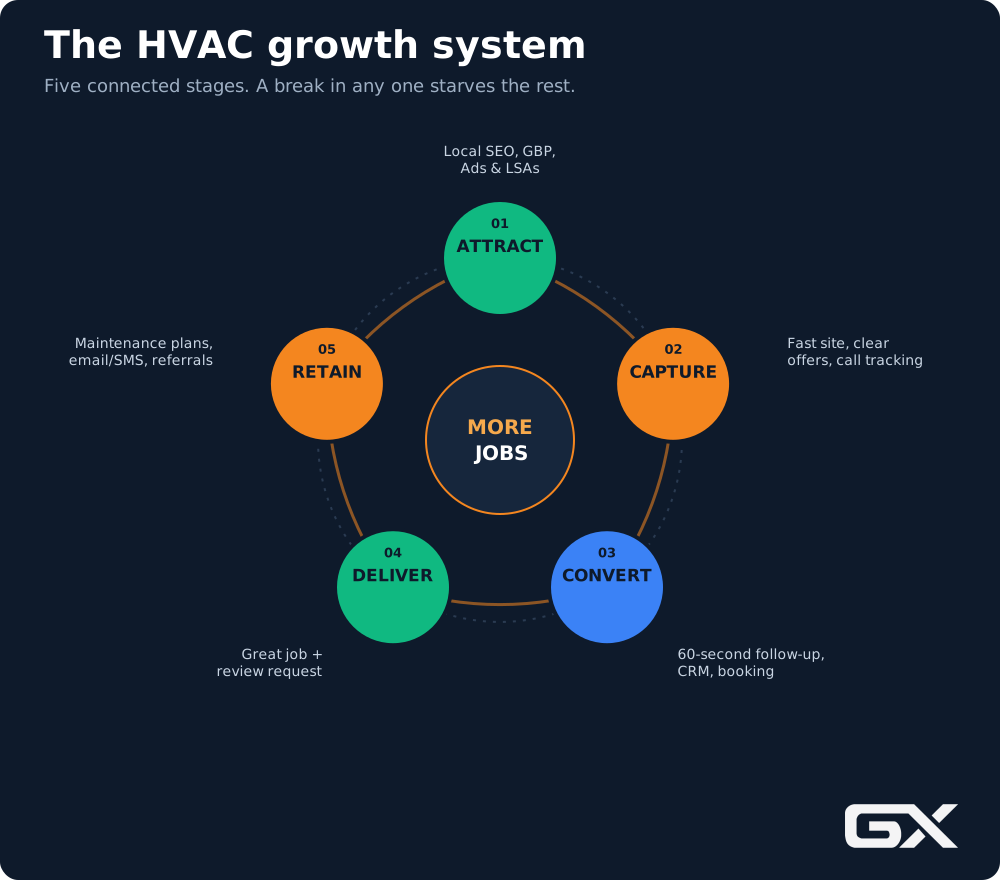
The five stages:
- Attract — Get found when a homeowner needs you: local SEO, Google Business Profile, Google Ads, and Local Services Ads.
- Capture — Turn that attention into a contact: a fast website, clear offers, prominent click-to-call, and call tracking so you know what’s working.
- Convert — Turn the contact into a booked job: near-instant follow-up, a CRM that doesn’t drop leads, and an easy booking process.
- Deliver — Do excellent work and ask for the review while you’re still on-site or same-day.
- Retain — Bring customers back: maintenance plans, email and SMS, and a referral program.
The reason to think in systems is leverage. A 10% improvement in attraction gives you 10% more leads.
But a 10% improvement at every stage compounds — more leads, a higher share captured, more converted, more retained — and the result is often a doubling of booked revenue from roughly the same spend.
The companies that win don’t have one great channel. They have a loop with no major leaks.
The rest of this guide walks through each stage in order. Start where your biggest leak is.
Local SEO for HVAC companies
Local SEO is how you get found organically when someone searches “furnace repair [your city]” or “AC installation near me.”
Unlike ads, it’s an asset you build once and benefit from for years — a $0-per-click lead source once it’s ranking.
The trade-off is time: expect early movement in three to four months and dominant rankings for competitive terms in six to twelve.
The three levers that move local rankings are proximity, relevance, and prominence.
You can’t change where a searcher is standing, but you can heavily influence the other two.
Nail your NAP consistency. Your Name, Address, and Phone number must be identical everywhere they appear — your website, Google Business Profile, Yelp, Angi, the Better Business Bureau, and every directory.
Inconsistent listings confuse search engines and dilute your authority. Audit them once, fix them, and keep them consistent.
Build out service and location pages. One thin “Services” page won’t rank.
Create a dedicated, genuinely useful page for each core service (AC repair, AC installation, furnace repair, heat pump installation, indoor air quality, maintenance plans) and for each city or area you serve.
A page titled “AC Repair in [City]” that speaks to local homeowners — naming neighborhoods, mentioning the local climate, answering real questions — will outrank a generic competitor every time.
Avoid spinning up dozens of near-identical “doorway” pages; Google penalizes thin duplication. Each page should earn its place.
Target the searches that convert. Broad terms like “HVAC” bring traffic but little intent.
Long-tail, local, problem-specific phrases convert far better: “cost to replace a 3-ton AC unit in [city],” “why is my furnace blowing cold air,” “emergency AC repair [city].” Lower volume, much higher booking rate.
Earn local relevance signals. Get listed in local directories and your chamber of commerce, sponsor a local team or event (which often earns a link), and publish content that local blogs might reference.
Natural, white-hat links from reputable local and industry sources build authority.
Steer clear of paid link schemes — they risk a manual penalty that can erase your rankings.
Prepare for AI and “near me” search. With AI Overviews now appearing on a large share of queries, clear, well-structured, genuinely helpful content that directly answers homeowner questions is increasingly what gets surfaced.
Structured service pages, FAQs, and schema markup help both traditional search and AI features understand and recommend you.
For the complete step-by-step playbook, see our Local SEO Guide for Service Businesses.
Google Business Profile optimization
If local SEO is the strategy, your Google Business Profile (GBP) is the engine.
It appears in up to 93% of local searches and is often the only thing a homeowner looks at before calling — the name, the star rating, the photos, the “open now,” the call button.
For most HVAC companies, an optimized GBP is the single highest-ROI marketing hour available.
Work through this checklist:
- Claim and verify the profile if you haven’t. Then confirm the basics are perfect: exact business name (no keyword stuffing), phone, website, and hours, including holiday hours.
- Choose the right categories. Set your primary category to the most accurate option (e.g., “HVAC contractor” or “Air conditioning contractor”) and add relevant secondary categories. Category choice is a major ranking factor.
- Define your service area accurately if you’re service-area-based, and keep your address handling consistent with how you operate.
- Write a complete services list using real service names homeowners search for, each with a short, locally worded description.
- Add real photos — and keep adding them. Trucks, technicians on the job, before-and-afters, your team.
Fresh photos signal an active, legitimate business and boost click-through rates. (Frame before-and-after images as representative examples of your work, not as fabricated case studies.)
- Post regularly. Use GBP posts for seasonal offers (“Spring AC tune-up special”), tips, and announcements. It keeps the profile active and gives you another surface in search.
- Collect and respond to reviews (covered in depth below). Recency and response rate both matter.
- Use the Q&A section. Seed it with the real questions you get and answer them clearly.
Treat your GBP as a living asset, not a set-it-and-forget-it listing. The companies dominating the map pack are the ones updating it every week.
HVAC website optimization
Your website has one job: turn a visitor into a booked job (or at least a phone call).
Most HVAC sites leak here badly — they’re slow, they bury the phone number, and they read like a brochure instead of a booking tool.
Speed first. Remember that over half of mobile visitors leave if a page takes more than about three seconds.
Compress images, use modern hosting, and run your key pages through Google’s PageSpeed Insights. Speed is both a ranking factor and a conversion factor.
Make contact effortless. Your phone number should be tappable and visible in the header on every page, especially on mobile, where most HVAC searches happen.
Add a sticky call button and a short “Request Service” form (name, phone, problem, ZIP — nothing more). Every extra field is a leak.
Build for the emergency mindset. A homeowner with a dead system is stressed and in a hurry.
Above the fold on your homepage and service pages, answer three questions instantly: Do you fix my problem? Do you serve my area? How fast can you come?
Trust badges (licensed, insured, Google Guaranteed, years in business), your star rating, and a clear emergency-service line do more than any amount of clever copy.
Use conversion-focused service pages. The proven structure: problem → solution → proof (reviews) → clear call to action.
Add financing options for big-ticket replacements, real pricing ranges where you can, and an obvious booking path on every page.
Track everything. Install call tracking (so you know which channel drove the call), conversion tracking on forms, and analytics.
You can’t optimize a system you can’t measure — and “the phone rang” is not a measurement.
Our HVAC Website Optimization Guide goes deep on layout, speed, and conversion design.
Google Ads for HVAC
When you need leads today — to fill a slow week or capture peak-season demand — paid search is the fastest lever you have.
It puts you at the top of the results for high-intent searches within hours of launching.
But it’s also where HVAC budgets quietly bleed out, so structure matters more than spend.
What it costs. HVAC is a competitive, high-value category, so clicks aren’t cheap.
The blended cost per click sits around $9 in 2026, with a typical range of roughly $7 to $12 (PPC Chief). Cost per lead varies dramatically by campaign type.
According to SearchLight’s 2026 benchmark — built on nearly $15 million in spend across 816 HVAC and plumbing contractors — the blended HVAC cost per lead is about $104, but that average hides a wide spread:
- Branded search (people searching your company name): ~$34 per lead.
- Non-branded search (people searching “AC repair near me”): ~$149 per lead — this is your real new-customer acquisition number.
- Performance Max: ~$72 per lead.
Structure campaigns by service line, not by “HVAC.” This is the highest-leverage move in the whole channel.
Running separate campaigns for “AC repair,” “furnace repair,” and “AC installation” — instead of one broad “HVAC” campaign — lets Google match intent precisely and typically cuts cost per lead by 15–25%.
The benchmark data shows why: segmented heating-repair campaigns run around $144 per lead with strong economics (a ~38% booking rate and ~$3,200 average ticket), while general, unsegmented HVAC campaigns run closer to $198 per lead for worse results.
Run a branded campaign. Many owners skip this, assuming they’ll get those clicks for free organically.
But branded leads cost roughly a third as much as non-branded ones, and a branded campaign protects your name from competitors bidding on it.
Allocating even 5–10% of the budget to branded search lowers your blended cost per lead by a noticeable amount.
Protect your budget from waste. The most common leak in HVAC paid search is broad-match keywords with no controls, which trigger your ad for irrelevant searches (“HVAC repair certification,” “DIY furnace fix,” competitor brands).
Build a tight negative-keyword list, use phrase and exact match deliberately, and add negatives for “jobs,” “training,” “DIY,” “parts,” and “salary.”
Send clicks to a matched landing page. Don’t dump ad traffic on your homepage.
A click for “emergency AC repair” should land on a focused page about emergency AC repair, with a phone number and a form above the fold.
This single fix often doubles the conversion rate.
Remember the math behind the math. A $149 lead sounds expensive until you weigh it against an average ticket of several hundred dollars on a repair, or roughly $10,000 on a system replacement.
With a healthy close rate, well-run HVAC paid search commonly returns three to ten times its spend once campaigns mature. But none of that works if the phone goes unanswered.
The best Google Ads campaign in the world loses to a competitor who simply picks up faster.
Local Services Ads (Google Guaranteed)
Local Services Ads (LSAs) deserve their own section because they’re often the single best paid channel for HVAC — and they work differently from regular Google Ads.
LSAs sit at the very top of the results, above traditional ads, with a green “Google Guaranteed” badge that signals Google has verified your license, insurance, and background.
Crucially, you pay per lead, not per click.
A homeowner who actually calls or messages you generates a charge; a curious browser who clicks around does not.
The economics are compelling. LSA leads for HVAC commonly run in the $25–$85 range, depending on your market — frequently cheaper than non-branded Google Ads leads, and often higher-intent because the person is contacting you directly with a problem to solve.
The Google Guaranteed badge also builds instant trust, boosting conversions.
To win with LSAs:
- Get verified — complete the license, insurance, and background-check process to earn the badge. This is the gate; don’t skip it.
- Keep your response time fast and your answer rate high. Google factors responsiveness into your ranking and lead flow.
Missed-call leads are both a wasted charge and a ranking penalty.
- Dispute bad leads. You can flag and request credit for leads that are clearly out of area, spam, or for services you don’t offer.
Do it consistently; it protects your cost per lead.
- Pour fuel on it seasonally. LSAs scale beautifully with demand.
Increase your weekly budget during cooling and heating peaks when intent is highest.
For most residential HVAC companies, the right answer isn’t LSAs or Google Ads — it’s LSAs first (cheapest, highest-trust leads), then Google Ads to capture the high-intent searches LSAs don’t cover.
HVAC content marketing
Content marketing is how you earn trust before the emergency and rank for the questions homeowners ask on the way to hiring.
It’s a long game, but it compounds: a single strong guide can generate organic leads for years.
Think in terms of the homeowner’s journey:
- Awareness (“why is my AC freezing up,” “10 signs you need a new furnace,” seasonal maintenance checklists) — these capture early searchers and build authority.
- Consideration (“repair vs. replace your AC,” “how much does a new heat pump cost in [city],” financing explainers) — these reach people actively deciding.
- Decision (local service pages, reviews, FAQs, financing) — these convert.
A practical, sustainable cadence for a local HVAC company is one to two genuinely useful pages a month — a mix of technical “how-to / why” guides and cost guides, all written for homeowners, not other contractors.
Quality beats volume: one page that thoroughly answers “cost to replace an AC unit in [city]” with real local ranges will out-earn ten thin posts.
Content also feeds every other channel. A good guide gives you something to post on GBP, share by email, and link to from ads.
And data-driven content — original local cost ranges, seasonal tips — tends to earn the natural backlinks that lift your whole site’s rankings.
HVAC review generation
Reviews are not a vanity metric in HVAC — they are a primary driver of both rankings and conversion.
With roughly 87% of consumers reading reviews before choosing a local business, your star rating and review count are often the deciding factor between you and the company ranked next to you.
Two things matter most: volume and recency. A steady stream of recent reviews signals an active, trusted business.
A pile of five-star reviews from three years ago does not. The goal is a consistent flow, not a one-time push.
Build a system, not a habit:
- Ask every customer, every time, at the right moment — when the job is done, and the customer is happy, ideally before the technician leaves.
“Would you mind leaving us a quick Google review? Here’s a link.” Train every tech and CSR to do it.
- Make it one tap. Send a text or email with a direct link to your Google review form. Friction kills review rates.
Automated post-job review requests (covered in automation below) are the single most reliable way to scale this.
- Respond to every review — positive and negative. Thank happy customers by name.
For negative reviews, respond calmly, professionally, and with a path to resolution; a well-handled complaint often impresses future readers more than a flawless record.
- Never buy or fake reviews. It violates platform policies and destroys trust when discovered. Earn them.
A simple rule of thumb: if you complete 200 jobs a month and ask every customer, even a 15–20% conversion to reviews puts you well ahead of nearly every competitor within a year.
Our HVAC Local Lead Checklistincludes the exact review-request workflow and the rest of the local-visibility essentials in a printable 31-point format.
HVAC referral programs
Referred customers are the highest-quality, lowest-cost leads in the trade.
They arrive pre-trusted, close faster, haggle less, and tend to stay longer. Yet most HVAC companies leave referrals entirely to chance.
Turn it into a system:
- Make a clear, simple offer. A common structure: give the referrer a reward (a gift card, account credit, or a free tune-up) and the new customer an incentive (a discount on first service).
Keep it easy to understand and easy to redeem.
- Ask at the peak moment. The best time to ask for a referral is right after you’ve delivered great work and earned a great review.
“If you know a neighbor who needs us, here’s a card — they get $50 off, and you get a free tune-up.”
- Equip your team and your follow-ups. Give techs referral cards. Mention the program in post-job emails and texts. Put it on invoices.
- Track and reward promptly. Nothing kills a referral program faster than a reward that never shows up. Close the loop fast.
Referrals also stack with reviews and retention — the same happy customer who leaves a five-star review is your best source of the next one.
HVAC email and SMS marketing
This is the most underused, highest-margin channel in HVAC — and it’s a direct fix for the “no nurture” leak.
Industry data is striking: marketing to your existing customer database returns roughly $8–$12 per dollar spent, versus about $3–$4 per dollar spent on new-customer acquisition (ACCA).
Yet most contractors pour 70–80% of their budget into chasing strangers while their owned audience goes cold.
Your list — every customer you’ve ever served — is an asset. Put it to work:
- Seasonal tune-up reminders. The backbone of HVAC email/SMS.
Remind customers in spring to schedule an AC tune-up and in fall to schedule a furnace tune-up, before the rush. These convert because the timing matches the real need.
- Maintenance-plan promotion and renewals. Automated reminders to join or renew (more on plans below).
- Filter-replacement and service nudges. Helpful, low-pressure touches that keep you top of mind.
- Win-back campaigns. Reach out to customers you haven’t seen in 12–24 months with a reason to call you first.
- Post-job follow-ups. A thank-you, a review request, and the referral offer — automatically.
A few practical notes: SMS gets read almost immediately and is ideal for time-sensitive reminders and appointment confirmations, but use it sparingly and always with consent.
Email carries the longer messages. Segment your list (by service history, plan status, last-service date) so the message fits the customer.
And always make it easy to opt out — respecting that keeps your list healthy and compliant.
HVAC automation and speed-to-lead
Automation is what makes everything above run without you babysitting it — and its highest-value job is closing the speed-to-lead leak that costs HVAC companies more than any other.
Recall the stakes: most customers hire whoever responds first. Responding within about a minute dramatically lifts conversion, and waiting five minutes sharply cuts a lead’s value.
Humans can’t hit those numbers reliably during a busy day. Automation can.
Build these automated flows:
- Instant lead response. The moment a web form is submitted or a missed call comes in, fire an automatic text: “Thanks for reaching out to [Company] — we got your request, and we’ll call you in the next few minutes. Need us now? Call [number].”
This single automation can be the difference between booking the job and losing it to the next contractor.
- Missed-call text-back. If a call goes unanswered, an automatic text goes out immediately so the lead doesn’t simply move on. This recovers an enormous amount of after-hours and overflow volume.
- Appointment confirmations and reminders. Automatic texts that cut no-shows.
- Automated review requests. Triggered the moment a job is marked complete in your system.
- Nurture sequences. Seasonal reminders and win-backs that run on a schedule, hands-off.
The principle: a homeowner should never wait — and never feel ignored — even when your whole team is on a roof or under a house.
Automation buys you the response speed that wins the job, then frees your people to do the work.
HVAC CRM systems
A CRM (customer relationship management system) is the spine that holds the growth system together. Without one, leads live in voicemails, sticky notes, and inboxes — which is exactly how they leak.
With one, every lead is automatically captured, tracked, and followed up on.
For HVAC specifically, look for a platform that connects the field to the office:
- Lead capture from every source (web forms, calls, LSAs, ads) into one pipeline, so nothing falls through the cracks.
- Automated follow-up and the instant-response flows described above.
- Scheduling and dispatch that the office and technicians share in real time.
- Customer history — equipment installed, past service, maintenance-plan status — so every interaction is informed.
- Review and reminder automation built in or easily integrated.
- Reporting that ties marketing spend to booked jobs, not just leads.
Field-service platforms built for the trades (the category includes tools like ServiceTitan, Housecall Pro, Jobber, and others) combine CRM, scheduling, dispatch, and invoicing in one place.
The right choice depends on your size and budget — but the non-negotiable is that it captures every lead and automates follow-up.
A CRM that just stores contacts isn’t doing its job; one that acts on them is.
Seasonal marketing strategies
HVAC demand swings harder by season than almost any other trade. Your marketing calendar — and your budget — should swing with it, leaning into peaks and using the shoulder seasons to set up the next surge.

A season-by-season playbook:
- January–March (heating peak / late winter). No-heat emergencies drive urgent searches.
Keep Google Ads and LSAs funded for “furnace repair” and “no heat” terms, and lean into indoor air quality, which sells well in winter.
Begin teeing up spring AC tune-ups toward the end of this window.
- April–May (spring shoulder). This is your pre-season setup.
Push AC tune-up specials before the first heat wave, when homeowners are receptive, and your schedule is open. Email your whole list.
Booking tune-ups now both smooths your revenue and surfaces the systems that should be replaced before summer.
- June–August (cooling peak). Highest demand and highest intent of the year.
The strategy here is capacity, not discounts — you don’t need to cut prices when the phone is ringing.
Maximize LSA and Google Ads budgets to capture emergency AC searches, and make sure your follow-up and booking are airtight, because this is when leaks cost the most.
- September–October (fall shoulder). Mirror the spring move with furnace tune-up campaigns before the cold hits, and run your hardest maintenance-plan enrollment push of the year.
Customers who sign up now will call you first all winter.
- November–December (early heating). No-heat emergencies return. Combine emergency service campaigns with end-of-year reactivation offers for past customers and any year-end equipment promotions.
The strategic principle, backed by ACCA guidance, is to front-load 60–70% of your annual marketing spend into your peak four to six months, when intent and acquisition efficiency are highest — rather than spreading budget flatly across a calendar that doesn’t match real demand.
Spend where the demand is.
Retention strategies
Acquiring a new customer costs several times as much as keeping one — and in HVAC, where a relationship can span decades of tune-ups, repairs, and eventual replacement, retention is where the real money lies.
The crown jewel of retention is the maintenance plan.
A maintenance agreement (typically a recurring annual or monthly fee for seasonal tune-ups plus perks like priority service and repair discounts) does three powerful things:
- Creates recurring, predictable revenue — worth roughly $300–$600 per customer per year before any repair or replacement work.
- Locks in loyalty. Plan members call you first when something breaks, and they’re far more likely to buy their next system from you. They essentially stop shopping around.
- Generates repair and replacement opportunities through regular visits that catch problems early.
Build retention deliberately:
- Sell the plan on every job. Train technicians to offer it after good service, when trust is highest.
- Automate renewals and reminders so plans don’t lapse silently.
- Stay in touch year-round with the email/SMS program — seasonal tips, reminders, and the occasional check-in — so you’re the obvious choice when they need service.
- Deliver a “wow” on the first job. Retention starts with the experience: on-time arrival, clean work, and clear communication.
The best retention marketing is work worth coming back to.
Protecting your existing base is also your safest hedge against a slow month of new leads — which is why, if budget is ever tight, retention marketing should be the last thing you cut, not the first.
Revenue growth strategies
Once the system is running and the leaks are plugged, growth comes from three levers — and adding customers is only one of them.
The other two are usually faster and cheaper.
- Raise average ticket value. Train technicians to present good-better-best options, recommend appropriate add-ons (indoor air quality, smart thermostats, surge protection, ductwork), and offer financing that makes a full system replacement feel attainable.
A modest lift in average ticket flows almost entirely to profit. The marketing job here is supplying the proof and offers that make the upsell credible.
- Increase booked-job rate. This is the leak work, restated as a growth lever.
Improving how fast you respond and how well you convert leads you already have is often the single highest-ROI growth move available — no extra ad spend required.
- Add customers profitably. The traditional lever: more leads through the channels in this guide, converted by a system that holds water.
The discipline that ties it together is measurement. Track cost per lead and cost per booked job by channel, your close rate, and your average ticket.
Then move money toward whatever produces profitable booked jobs and away from whatever just produces activity.
Impressions don’t dispatch trucks; booked jobs do.
The owners who won in 2026 aren’t spending more—they’re spending into the channels their own data shows are working.
Your HVAC marketing budget
The most common budget questions are how much and where. Here’s a grounded answer to both.
How much? As a percentage of revenue, healthy HVAC companies generally land in these ranges:
- Under $1M / early growth: 10–15%. You’re building a customer base from scratch, and every new customer compounds.
- $1M–$3M / scaling: 8–12%. Concentrate on the channels already booking jobs and reinvest the wins.
- $3M+ / established: 5–8%. Referrals and repeat customers carry more of the load; spend protects your position and funds new markets.
In dollar terms, that tends to mean roughly $2,000–$6,000 a month for companies doing $500K–$5M, scaling up from there.
These are starting points, not rules — a company entering a new service area spends more; a company at capacity spends to protect margin rather than chase volume.
Where. A sensible starting allocation for a growth-stage residential HVAC company:

The line most owners underfund is database marketing — email and SMS to existing customers — which, as noted, returns several times what new-customer acquisition does.
The line most owners over-fund is undifferentiated new-customer acquisition. Rebalancing toward your owned audience is often the fastest way to improve profits on this list.
Two rules keep a budget honest: tie it to a target (if you need 30 more jobs a month, work backward through your close rate and cost per lead to the spend required), and review it monthly, shifting dollars from what’s producing activity to what’s producing booked jobs.
The 12-month growth roadmap
You can’t fix everything at once, and you shouldn’t try. Sequence the work so each phase builds on the last — plug the leaks first, then turn up the volume, then compound it.

- Phase 1 — Days 0–30: Stop the bleeding. Claim and optimize your Google Business Profile.
Put call tracking in place and set up instant lead response and missed-call text-back.
Fix your website’s speed and mobile call-to-action. Turn on automated review requests.
None of this requires more ad spend — it makes every existing lead worth more.
- Phase 2 — Months 1–3: Turn on demand. Launch Local Services Ads and get Google Guaranteed. Stand up service-segmented Google Ads.
Build out your core service and city pages. Put a real CRM and pipeline in place so the new volume doesn’t leak.
- Phase 3 — Months 3–6: Build the asset. Start the local SEO and content engine that pays off for years.
Launch your maintenance-plan offer, your email/SMS nurture flows, and your referral program — the retention machine.
- Phase 4 — Months 6–12: Compound it. Double down on the channels your data proves book jobs.
Run the full seasonal calendar. Activate win-back and reactivation campaigns.
Expand your service area or service lines from a foundation that now holds water.
By the end of a year, you’ve gone from a leaky pipe to a connected growth system: more leads in, far more booked jobs out, and a base of loyal customers driving repeat and referral revenue.
Putting it all together
Here’s the whole guide in one breath. You probably don’t have a lead problem — you have a leak problem.
Plug the leaks (speed-to-lead, visibility, website, reviews, nurture) and the leads you already pay for produce dramatically more booked jobs.
Build the five-stage system — attract, capture, convert, deliver, retain — so the pieces connect rather than run in isolation.
Fund it at a level matched to your stage, weighted toward your peak seasons and your owned audience.
Then measure relentlessly and pour money into whatever books or jobs you want.
Do that, and HVAC marketing stops being your biggest question mark and becomes your most reliable growth engine.
See where your leaks are first.
Run the HVAC Lead Leak Calculator to estimate the revenue slipping through your follow-up, visibility, and conversion gaps — then use the HVAC Local Lead Checklist to start plugging them this week.