


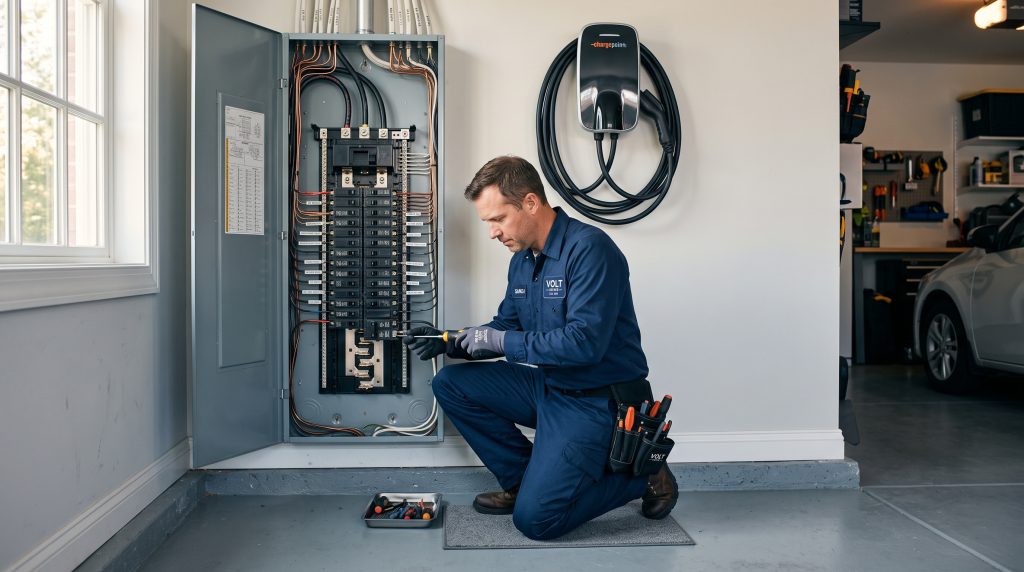
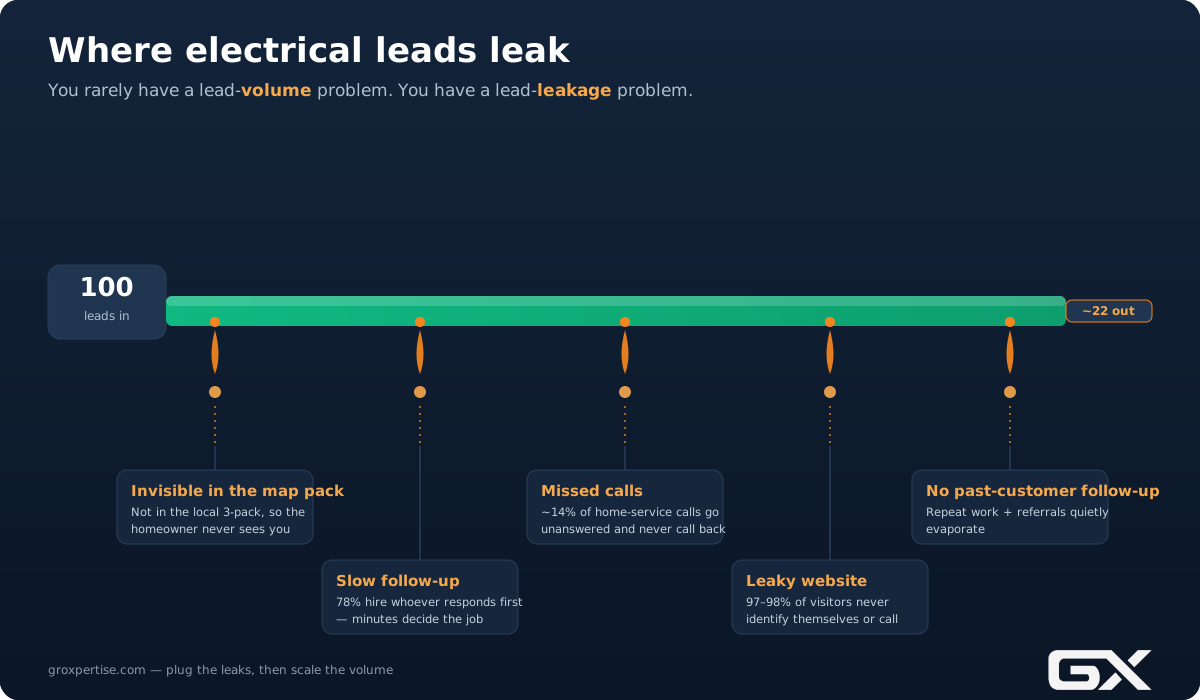
Most electrical contractors think they have a lead problem. They don’t. They have a leak problem.
Walk into almost any one-to-ten-person electrical shop, and you’ll hear the same thing: “We just need more leads.” But when you actually trace what happens to the demand already coming at them, the picture changes.
Calls go to voicemail during a panel install. A web form sits unanswered until the next morning.
A homeowner who searched “electrician near me” never saw the business because it wasn’t in the map pack. A past customer who’d happily pay for a surge protector never hears from the company again.
The demand was there. It leaked out before it ever became revenue.
That distinction is the whole game in 2026, especially in the electrical space. Demand for licensed electrical work is booming — EV chargers, panel upgrades, whole-home electrification, solar and battery, generators, data centers — while the trade is short on licensed labor. You can afford to be selective.
The job of marketing is no longer to pour in as many cheap leads as possible. It’s to plug the leaks, capture high-intent demand, convert it fast, and grow the value of every customer you already have.
This guide gives you the complete system. We’ll cover the industry backdrop, then build the growth engine piece by piece: local SEO and Google Maps, your website, Google Ads and Local Services Ads, the split between residential and commercial, referrals, reviews, content, email, automation, retention, and the high-margin revenue you’re probably leaving on the table.
Throughout, you’ll get real 2026 benchmark numbers, simple frameworks, the KPIs that matter, and a 90-day roadmap you can start on Monday.
What’s inside
- The electrical industry in 2026: a demand-rich, leak-prone market
- Building an electrical growth system
- Local SEO: owning your service area
- Google Maps and the local 3-pack
- Website optimization: stop the silent leak
- Google Ads: buying high-intent clicks
- Local Services Ads: the highest-ROI channel for electricians
- Commercial vs. residential marketing
- Referral marketing: your cheapest leads
- Review management: the trust engine
- Content marketing: compounding visibility
- Email marketing: the channel you own
- Automation: speed-to-lead and follow-up
- Customer retention: plugging the back-door leak
- Revenue expansion: grow the customer, not just the list
- KPI tracking: measuring the whole system
- Your 90-day growth roadmap
- Where to start
The electrical industry in 2026: a demand-rich, leak-prone market
Before you spend a dollar on marketing, understand the landscape you’re operating in, because it changes what “good marketing” even means.
The U.S. electrical contracting market is large and growing fast. Estimates vary by methodology — you’ll see figures from roughly $225 billion a few years ago to well over $300 billion in some 2025 analyses, with projections continuing to climb toward the end of the decade — but every credible source agrees on the direction: up and to the right.
The drivers are structural, not cyclical. Electric-vehicle adoption means almost every new EV owner needs a Level 2 home charger.
Aging housing stock, much of it still on 100-amp service, can’t handle modern loads from heat pumps, induction ranges, EV chargers, and solar without a panel upgrade.
Battery storage, generators, smart panels, and data-center construction add further pull.
The defining constraint is a labor shortage, not a demand shortage.
The Bureau of Labor Statistics projects electrician employment to grow about 9% from 2024 to 2034 — roughly three times the average occupation — with on the order of 81,000 openings a year, much of it replacement demand as experienced electricians retire.
Longer-range industry studies have warned that the workforce gap could widen dramatically by 2040.
Here’s why that matters for marketing. When demand outstrips licensed supply, the smartest electricians stop chasing volume and start chasing quality.
A $40 lead that turns into a $3,500 panel upgrade or a $2,000 EV-charger install is worth ten low-margin troubleshooting calls that tie up a crew.
Your marketing should pre-qualify, attract high-margin work, and filter out the cheap jobs — while building enough trust and brand that you can charge what you’re worth.
And the buyer’s journey has accelerated. The vast majority of customer experiences now start with a search engine, and homeowners commonly touch multiple platforms — Google, Maps, Nextdoor, reviews — before they ever contact a contractor.
The window to win has collapsed: responding within the first minute or two can multiply your conversion rate, and a large share of buyers simply hire whoever responds first.
Every one of those touchpoints is a place where leads either flow through or leak out.
Building an electrical growth system
Disconnected tactics are the most expensive way to grow.
A great website with no traffic does nothing. Lots of traffic landing on a slow site does nothing. Booked jobs with no follow-up never compound.
The contractors who win treat marketing as a system — five connected stages, where a leak at any one drains the whole engine.
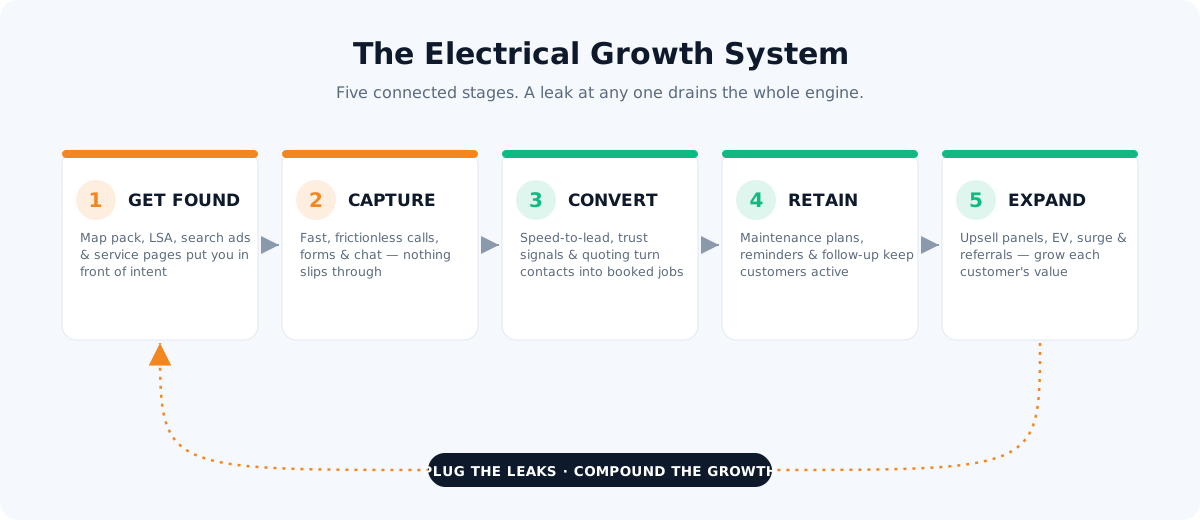
The five stages are simple to name and unforgiving to skip:
- Get found.
Show up where intent already exists — the map pack, Local Services Ads, search ads, and service pages that match what people type. - Capture.
Make it effortless to reach you. Click-to-call, short forms, web chat, and a phone that always gets answered.Most contractor sites convert only 2–3% of visitors into an identified lead; the other 97–98% leave anonymously.
That gap is the biggest, quietest leak in the trade.
- Convert.
Turn contacts into booked jobs with speed, trust signals (license number, reviews, the Google Guaranteed badge), and a clear quoting process.Speed is the single highest-leverage variable here.
- Retain.
Keep customers active with maintenance and safety plans, seasonal reminders, and proactive follow-up so you’re not re-acquiring them at full price every time. - Expand.
Grow the value of each customer — upsells, add-ons, referrals — so one $250 service call becomes a multi-year, multi-thousand-dollar relationship.
A useful way to think about your channel mix as you build the system: roughly 40% from paid (Local Services Ads plus Google Ads), 30% from organic and your Google Business Profile, 20% from referrals and repeat customers, and 10% from everything else (email, SMS, social, direct mail).
Those owned channels — referrals, repeat, email — are where you get unfair leverage, because the cost per contact is near zero and the audience is already qualified.
If your last marketing-driven sale to a past customer was more than 30 days ago, that owned channel is leaking.
The rest of this guide walks through the system stage by stage.
We’ll start with getting found, because nothing downstream matters if intent never reaches you — but remember the order of operations: plug the leaks first, then turn up the volume.
Pouring leads into a leaky funnel just makes the waste more expensive.
Local SEO: owning your service area
Electrical work is local.
When someone needs an electrician, they search with local intent — “electrician near me,” “panel upgrade [city],” “emergency electrician [neighborhood]” — and Google answers with a local-first results page.
Local SEO is how you make sure that answer is you. It’s the foundation channel because, once you rank, it produces leads at effectively zero marginal cost.
Three things drive local rankings: relevance (does your profile and site match the search), proximity (how close you are to the searcher), and prominence (reviews, citations, links, and overall authority).
You can’t move your trucks closer to every homeowner, but you can win decisively on relevance and prominence.
Start with your service-area strategy. Decide the towns, neighborhoods, and ZIP codes you actually want to work in, and build dedicated, genuinely useful service-area pages for the important ones — not thin doorway pages, but real content about the work you do there.
Pair those with service pages for each high-value job type: panel upgrades, EV charger installation, whole-home rewiring, generator installation, lighting, troubleshooting, and commercial electrical.
Service-specific pages capture project-intent searches that a generic “electrical services” page never will, and they’re exactly where high-margin work hides.
Make sure the technical basics are solid: a fast, mobile-first site (we’ll cover this in depth shortly), consistent name, address, phone information everywhere it appears online, structured data so search engines understand your services and service area, and clean internal linking between your homepage, service pages, and location pages.
Build citations on the directories that matter for trades — Google, Bing, Yelp, Angi, and industry-specific listings — and keep your license number visible, because in a licensed trade that’s both a trust signal and a ranking-relevant detail.
Illustrative composite
A two-truck residential shop that builds five tight service-area pages and four service pages — each answering the real questions homeowners ask — typically starts surfacing for long-tail, high-intent searches within a few months, capturing project work (panels, EV chargers) that competitors relying on a single homepage simply never appear for.
The point isn’t a magic number; it’s that structured, intent-matched pages plug the “invisible in search” leak.
Google Maps and the local 3-pack
When someone searches for an electrician, the most valuable real estate on the page isn’t the ads or the blue links—it’s the map with three business listings: the “local 3-pack.”
Those listings are Google Business Profiles, and getting into that pack is the highest-leverage free move in local marketing.
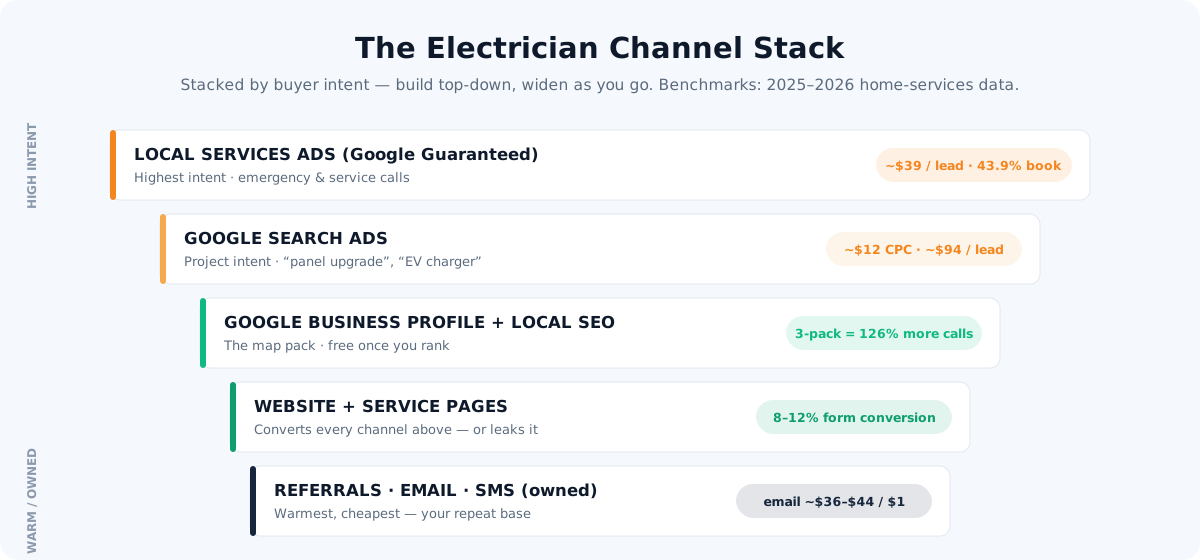
Businesses in the 3-pack capture a large majority of clicks and calls; one widely cited figure puts it at well over 100% more calls than businesses ranked below it.
If you’re not one of the three, you effectively don’t exist for most searchers.
Your Google Business Profile is free, and a fully optimized one can meaningfully lift your call volume — contractors who keep photos, reviews, and details current routinely see several times more calls than those with thin, neglected listings.
Treat it like a storefront you maintain weekly, not a set-and-forget directory entry.
A complete electrician profile has every field filled: name, address (or service-area settings if you don’t take walk-ins), hours, phone, and website.
List each service separately — panel upgrades, EV charger installation, rewiring, lighting, generator installation, troubleshooting — rather than burying them under “electrical services,” because the specific terms help you surface for specific searches.
Add ten or more real photos: clean panel work, labeled breakers, finished EV-charger installs, your crew, your branded truck. Real photos of tidy work outperform stock images by a wide margin.
Put your license number in the description. Post most weeks — a recent install, a seasonal safety reminder, a quick tip. Enable messaging, and answer it. And reply to every review, ideally within a day.
Reviews are the biggest lever of prominence in Maps, which is why review management gets its own section below.
For now, know that volume, recency, and your responses all feed your Maps visibility.
The map pack rewards businesses that look active, trusted, and complete—and punishes those that look abandoned.
Website optimization: stop the silent leak
Here’s a number worth pinning above your desk: around 72% of homeowners visit a contractor’s website before confirming a job, yet only 2–3% of the visitors to a typical home-service site ever identify themselves by calling or filling out a form. Everyone else leaves anonymously.
Your website is simultaneously the place most deals are won or lost and the single biggest silent leak in your funnel.
The good news is that the fixes are concrete. Your site needs to do four jobs well.
- Build instant trust.
A licensed trade lives or dies on trust. Put your license number, insurance, and the Google Guaranteed badge (if you run Local Services Ads) where they’re impossible to miss.Show real reviews, real photos of your work, and real team members.
If a homeowner clicks your ad, lands on your site, and sees a “Not Secure” warning or no license anywhere, the trust evaporates — fix the site before you turn on ads.
- Load fast on mobile.
Most of your traffic is on a phone, often standing in front of a tripped panel.More than half of mobile visitors abandon a slow page, and speed directly affects both rankings and conversions.
Compress images, cut bloated plugins, and aim for a near-instant first impression.
- Make contact frictionless.
Click-to-call buttons that are always visible on mobile. Short forms — name, phone, problem — not a 12-field interrogation.Web chat or a “text us” option for people who won’t call.
The goal is to convert far more than the default 2–3%; well-built service sites can push form conversion into the 8–12% range.
- Match intent with dedicated pages.
Send EV-charger searchers to an EV-charger page with pricing ranges, the tax-credit note, and a clear next step — not your homepage.Same for panel upgrades, rewiring, and emergencies. Every dedicated page is a better-converting landing spot and a stronger SEO asset.
If you only do one thing this quarter, instrument and fix the website. It’s the cheapest place to recover leads you’re already paying to attract.
Google Ads: buying high-intent clicks
Google Search Ads put you at the top of the results page the moment someone searches — instant visibility you can turn on today. The trade-off is cost and discipline.
Electrician clicks are not cheap: the cost per click for electrical paid search averaged around $12 in 2025, one of the highest in home services, and high-intent commercial terms run higher still — some analyses put “commercial electrician near me” at around $19 a click.
Blended cost per lead from electrician Google Ads lands around $90–$105, depending on the market and the amount of non-branded traffic.
Because clicks are expensive, the winners are ruthless about intent and economics. A few principles:
- Bid where the margin is.
Project-intent terms — “panel upgrade [city],” “EV charger installation [city],” “house rewiring” — attach to high-ticket jobs and convert at sane costs.Emergency terms (“emergency electrician,” “24/7 electrician”) cost a premium per click but convert well because the searcher needs help right now, and emergency jobs often bill at 1.5–2x normal rates.
A $10 click that converts at 15% beats a $40 click that converts at 8% — chase profitable conversions, not cheap clicks or raw volume.
- Run the affordability math before you bid.
If your average job is worth $750 at a 30% margin and you convert half your leads, you can pay up to roughly $112 per lead and still be profitable.Know that ceiling for each service before you set budgets, because residential and commercial economics are completely different.
- Protect your budget with negatives and tracking.
Aggressive negative keywords keep you out of “electrician salary,” “DIY,” “electrician school,” and other money-wasters.Call tracking tells you which keywords actually book jobs, not just which ones get clicks. Without tracking, you’re optimizing in the dark.
Illustrative composite
A contractor who starts with a modest monthly budget, tightens to emergency and panel/EV keywords, adds call tracking, and kills losing terms each week will typically drive their effective cost per lead down meaningfully over the first quarter — not by spending more, but by leaking less of the spend on the wrong clicks.
The lesson generalizes: in paid search, optimization beats budget.
Local Services Ads: the highest-ROI channel for electricians
If you run one paid channel, run this one. Google’s Local Services Ads (LSAs) sit above every other paid result, carry the “Google Guaranteed” badge, and — crucially — charge per lead rather than per click.
You pay only when a homeowner actually calls or messages about a job you serve; wrong-number or out-of-area inquiries can be disputed and credited back.
The 2026 numbers for electrical specifically are excellent.
Based on a February 2026 SearchLight home-services benchmark spanning hundreds of contractors and well over 100,000 leads, electrical costs per lead average around $39—the lowest of the major trades, below HVAC and plumbing.
Across that dataset, the average book rate is roughly 44%, the average ticket is about $1,800, and closed return on ad spend lands near 7.8x.
In plainer terms: for every dollar of LSA spend that became a booked job, contractors invoiced close to eight.
Independent reports put LSA lead-to-customer conversion around 31%, versus about 12% for traditional pay-per-click — because the badge and the pay-per-lead model filter for serious buyers.
The Google Guaranteed badge matters more for electricians than for almost any other trade because it signals license verification, insurance, and background checks, with customer protection up to a capped amount.
In a trade where homeowners are nervous about who they let near their panel, that badge closes the trust gap before they ever reach your website.
How to run LSAs well: complete verification fully (license and insurance), set the job types you actually want — panel upgrades, EV chargers, troubleshooting, generator installs — so Google routes relevant leads, set a realistic weekly budget, answer every call fast (response speed affects ranking and conversion), and use the “rate this lead” feedback consistently, since that’s now the main lever for training Google on your lead quality.
One caveat the averages hide: the badge gets you the call, but your website still closes the deal. Dial in the site first.
A simple budget illustration
About $1,200–$1,500 a month buys on the order of 20–25 charged leads in many markets; at a ~35–44% book rate, that’s eight or nine booked jobs, and a single panel upgrade or EV install can pay for the whole month.
In dense metros, leads run pricier ($25–$50 each); in low-competition markets, a well-optimized account can see them in the $15–$25 range.
Commercial vs. residential marketing
One of the most expensive mistakes electrical contractors make is running a single marketing engine for two completely different buyers.
Residential and commercial work have different buyers, sales cycles, job values, channels, and proof points.
Trying to win commercial accounts with the residential playbook — or vice versa — quietly bleeds money.

Residential is emotional and urgent.
A breaker won’t reset, the lights flicker, and a new EV is sitting in the driveway. The buyer is the homeowner; the decision can happen in minutes to days, and trust plus speed win.
This is where Local Services Ads, Google Search Ads, an optimized Google Business Profile, reviews, and sometimes Nextdoor do the heavy lifting.
The creative that converts leans on outcomes and reassurance: avoiding a fire, passing inspection before a sale, getting power back on tonight, charging the car at home by the weekend.
Commercial is rational and relational.
The buyer is a facility manager, general contractor, or property manager; the cycle spans weeks to months and involves multiple stakeholders; and jobs range from tens of thousands to hundreds of thousands of dollars.
Here, capability and proof win — spec sheets, capacity to staff and schedule, safety records, licensing, and case studies of comparable projects.
The channels shift toward SEO for commercial service terms, LinkedIn and account-based outreach, bid relationships, and good old-fashioned relationship marketing with GCs and property groups.
Note that commercial accepts higher acquisition costs because the contract values justify them; a five-figure cost to land a six-figure service contract can be perfectly rational.
The practical rule: if you do both, split the budget, run separate campaigns, and track them as two separate businesses with two separate scoreboards.
Most electricians who blend them end up underfunding commercial and contaminating their residential metrics.
Pick which engine matters most for your growth goals this year, fund it properly, and don’t let the other one muddy your numbers.
Referral marketing: your cheapest leads
Referrals are the highest-trust, lowest-cost leads you’ll ever get, and most electrical shops treat them as something that just happens rather than a channel they actively run.
That’s a leak. A referred customer arrives pre-sold, closes faster, haggles less, and tends to refer others.
Make referrals systematic.
Ask at the moment of maximum goodwill — right after a clean install when the customer is visibly happy — and make the ask specific: “If you know a neighbor whose panel is as old as yours was, send them my way.”
Give people an easy mechanism: a simple card, a text with a link, or a short referral page.
Consider a structured program with a modest two-sided incentive (a gift card for the referrer, a discount or free safety inspection for the new customer); even a small, clearly communicated reward dramatically increases referral rates.
Don’t limit referrals to homeowners.
Build referral relationships with adjacent trades and businesses: HVAC companies (heat pumps drive panel work), solar installers, EV dealerships and charger manufacturers (many run certified installer programs), real estate agents and home inspectors (inspection findings create electrical work), and general contractors.
Becoming the trusted, licensed electrician that other professionals recommend creates a steady, near-free stream of qualified work.
A handful of strong partner relationships can outproduce a paid channel — and cost almost nothing to maintain beyond doing great work and staying responsive.
Review management: the trust engine
Reviews are no longer a nice-to-have—they’re the trust engine that powers Maps rankings, ad conversions, and the homeowner’s final decision.
The overwhelming majority of consumers read reviews before hiring a local business, and most won’t even consider a business rated below four stars.
In a licensed, safety-sensitive trade, your star rating and review count are often the deciding factor between you and the next listing.
Treat reviews as a process, not luck. The single biggest driver of review volume is simply asking every customer, every time, at the right moment — right after the work is done and the customer is satisfied.
Automate the ask with a text or email that links directly to your Google review page, removing every click of friction.
A steady drip of recent reviews matters more than a pile of old ones, because recency signals an active, trusted business to both Google and humans.
Spread the love across platforms, but prioritize Google first — it feeds your Maps visibility directly — then Yelp, Angi, and Facebook as relevant.
Respond to every review, positive and negative. Thank the happy ones (it reinforces the relationship and signals activity to Google).
Handle the negative ones calmly, publicly, and professionally: acknowledge them, take them offline to resolve, and never get defensive.
A well-handled negative review often builds more trust than a wall of five stars, because prospects see how you behave when something goes wrong.
Photos in reviews, mentions of the specific service (“200-amp panel upgrade,” “Tesla charger install”), and named team members all add credibility and even a small SEO benefit.
Content marketing: compounding visibility
Content marketing is how you stop renting visibility and start owning it.
Educational content — answering the real questions homeowners and businesses ask — improves your search rankings, builds authority, and increasingly gets you surfaced inside AI-powered search and assistants, which a growing share of buyers now use before they ever reach a contractor.
Content is slower than ads, but it compounds: a strong page on EV charger installation keeps generating leads for years.
For electricians, the highest-value content aligns with your highest-margin services.
Write genuinely useful guides on the questions people search: “Do I need a panel upgrade for an EV charger?” “How much does it cost to rewire a house?” “What size electrical service do I need?” “Signs your electrical panel is failing.”
Cover the topics riding the electrification wave — EV chargers, panel and service upgrades, solar and battery tie-ins, generators, smart-home and surge protection — because those are exactly the high-ticket jobs you want, and deep, well-structured content on them builds a durable moat as more search shifts to AI.
Video deserves a specific call-out.
A majority of home-service companies report higher conversions from explainer and walkthrough videos, and for a technical, trust-dependent trade like electrical, a short clip of you explaining the panel-upgrade process or showing a clean EV-charger install does more to build confidence than any amount of copy.
Repurpose one good shoot across YouTube (authority and search), short-form (TikTok, Reels, Shorts for reach), your service pages, and your Google Business Profile posts.
Keep the audience straight.
If you’re targeting homeowners, write for homeowners — plain language, costs, safety, peace of mind.
If you’re pursuing commercial, write for facility managers and GCs — capability, compliance, uptime, project management.
The leak to avoid here is producing generic content that speaks to no one; specific, intent-matched content is what actually works.
Email marketing: the channel you own
Paid channels rent you attention.
Email — along with SMS — is attention you own, and it’s one of the most profitable channels in the trade, with commonly cited returns of $36–$44 per dollar spent.
The reason is simple: the cost per send is near zero, and the audience is already qualified.
Every customer you’ve ever served and every lead who didn’t book are sitting on a list you can access for free. If you’re not, that’s revenue leaking out the back door.
Build the list deliberately: capture email (and mobile, with consent) on every form, every invoice, and every service call.
Then put it to work with a handful of campaigns that practically run themselves:
- Seasonal and safety reminders.
Storm-season generator checks, holiday-lighting load reminders, “is your panel ready for that new EV?” nudges.These create demand from your existing base when work is most likely to occur.
- Maintenance and inspection prompts.
Annual safety inspections, panel checks, surge-protection reminders — recurring touchpoints that book repeat work and surface upsells. - Lead nurture.
Many leads aren’t ready to inquire on the day they do. A short automated sequence — a helpful guide, a few reviews, a clear offer — keeps you top of mind so you win the job when they’re ready, instead of losing it to whoever followed up. - Win-back.
Customers you haven’t heard from in 6–12 months get a targeted offer or a useful seasonal reminder.Reactivating a past customer costs a fraction of acquiring a new one.
Segment where you can — homeowners vs. commercial, EV owners, customers due for a panel check — because a relevant message to the right segment outperforms a generic blast every time.
Automation: speed-to-lead and follow-up
Automation isn’t about replacing the human touch — it’s about making sure no lead ever falls through a crack because your crew was up a ladder.
Two automations matter more than all the rest because they plug the two most expensive leaks in the funnel.
Speed-to-lead.
This is the highest-leverage variable in your entire marketing system.
A large majority of buyers hire the company that responds first, and responding within the first minute or two can multiply conversion rates several times over.
Yet a meaningful share of home-service calls go unanswered, and web forms routinely sit for hours.
The fix is automation: an instant auto-response to every form, a missed-call text-back that fires the moment a call goes unanswered (“Sorry we missed you — this is [Company], how can we help?”), and routing that puts the lead in front of a human fast.
A missed-call text-back alone recovers a startling number of jobs that would otherwise have called the next electrician on the list.
Automated follow-up and nurture.
Most contractors quote a job once and never follow up.
Automate a polite sequence after every quote — a check-in, a few reviews, a gentle “still want us to hold that slot?” — and you’ll close jobs you were otherwise leaving on the table.
Wire the same logic into reviews (auto-ask after job completion), referrals (auto-ask a week later), and reactivation (auto-nudge dormant customers).
Tie it together with a simple CRM or field-service platform that captures every lead from every channel into one place, tags the source, and triggers these sequences automatically.
The goal is a funnel where every contact is captured, every contact is followed up, and nothing depends on someone remembering to do it at 7 p.m. after a long day.
Customer retention: plugging the back-door leak
Acquisition gets all the attention, but retention is where margin lives.
It costs far more to win a new customer than to keep an existing one, and your past customers already trust you, know your name, and have a home full of electrical systems that need ongoing attention.
Letting them drift away and re-buying them later at full acquisition cost is one of the most expensive leaks in the business — and one of the easiest to plug.
The most powerful retention tool for electricians is a membership or maintenance plan: an annual safety inspection, priority scheduling, a standing discount on service, and surge/panel monitoring for a modest recurring fee.
Plans do three things at once — they create predictable, recurring revenue, keep you in regular contact (every touch is a chance to capture new work), and dramatically increase the customer’s lifetime value.
Even a simple “annual electrical safety check” plan changes a one-time transaction into a multi-year relationship.
Beyond formal plans, retention is mostly about staying usefully present: seasonal reminders, proactive notes when codes or rebates change (new EV tax credits, code updates that make an upgrade smart), and a quick check-in after major installs.
The contractor who texts a customer six months after an EV-charger install to ask how it’s working — and mentions the surge protector that would safeguard it — is the contractor who gets the next three jobs.
Retention and the expansion we’ll cover next are two sides of the same coin: keep the relationship alive, and keep growing its value.
Revenue expansion: grow the customer, not just the list
The fastest path to more revenue usually isn’t more leads — it’s more value per customer and per job.
This is where the electrification wave turns into money, and where most electricians leave the most on the table.
Lead with the high-margin niches.
EV charger installation, panel and service upgrades, whole-home rewires, generators, battery storage, and smart-home and surge protection are the fastest-growing, highest-margin work in the trade.
Panel upgrades commonly run several thousand dollars at healthy gross margins; EV-charger jobs frequently attach a panel upgrade, turning a $1,500 install into a $5,000 project; battery and whole-home electrification packages reach well into five figures.
Position your brand around these — in your service pages, ads, content, and Google Business Profile — and you attract the work you actually want.
Upsell and cross-sell at the point of service.
Every service call is an opportunity to solve the next problem before it becomes an emergency.
The electrician at a tripped breaker panel is perfectly positioned to flag an aging panel, recommend surge protection, suggest whole-home protection for the new EV, or note that the home is one circuit away from being EV-ready.
Done honestly — as genuine recommendations tied to the customer’s own setup and goals — this raises average ticket and serves the customer better.
Attach and bundle.
Offer package pricing that bundles naturally related work: EV charger plus panel upgrade, generator plus surge protection, lighting retrofit plus smart controls.
Bundles raise the average job value and make the decision easier for the customer.
Partner into demand streams.
EV-charger and electrification networks, automaker and dealership installer programs, and solar/battery partners can route a steady flow of high-ticket, pre-qualified jobs to a licensed contractor who’s set up to take them.
These expand both your volume and the value of each job.
The mindset shift: stop thinking “lead → job → done.” Start thinking “lead → first job → maintenance → upgrade → referral.”
That sequence is how a single $250 service call becomes a multi-thousand-dollar, multi-year relationship — and how you grow revenue without proportionally growing ad spend.
KPI tracking: measuring the whole system
You can’t plug a leak you can’t see.
The contractors who grow predictably are the ones who measure the funnel end to end, find the biggest gap between two stages, and fix that first.
Vanity metrics — impressions, clicks, “likes” — don’t pay the bills; the numbers below do.
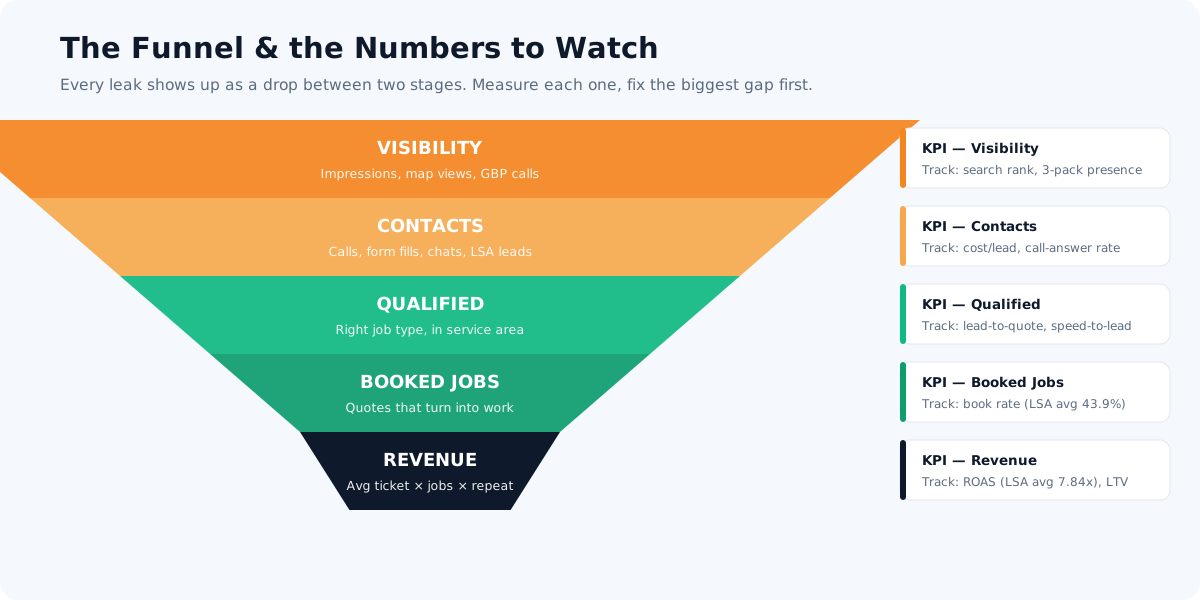
Track these by stage:
- Visibility.
Search rankings for your money keywords, presence in the local 3-pack, Google Business Profile views and calls, impressions on ads and LSAs.This tells you whether intent is reaching you at all.
- Contacts and cost.
Calls, form fills, chats, and LSA leads by channel; cost per lead by channel; and your call-answer rate.If a meaningful share of calls goes unanswered, that’s a leak no amount of ad spend can fix.
- Qualification and speed.
Lead-to-quote rate, and — the metric to obsess over — speed-to-lead (how fast you respond).Track the share of leads that are the right job type in your service area, so you can tune channels toward profitable work.
- Booked jobs.
Your book rate (for reference, LSA book rates average around 44%), close rate on quotes, and cost per booked job.This is where marketing turns into revenue.
- Revenue and return.
Average ticket, return on ad spend (LSA closed ROAS averages near 7.8x for electrical), customer lifetime value, and the mix of revenue by service so you can see whether the high-margin work is growing.
A few practical rules.
- Use call tracking so you know which channels and keywords produce booked jobs, not just clicks.
- Attribute revenue back to source, because average cost per lead is meaningless when one channel books $300 repairs and another books $5,000 panel jobs.
- Review weekly at first — cut losing keywords, scale winners, and watch for the stage where the biggest drop happens.
- And keep a simple one-page dashboard; a scoreboard you actually look at beats a perfect report you never open.
Your 90-day growth roadmap
You don’t build the whole system at once. You plug the leaks first, then open the taps, then compound.
Here’s a 90-day sequence that any electrical shop, from 1 to 10 people, can run.
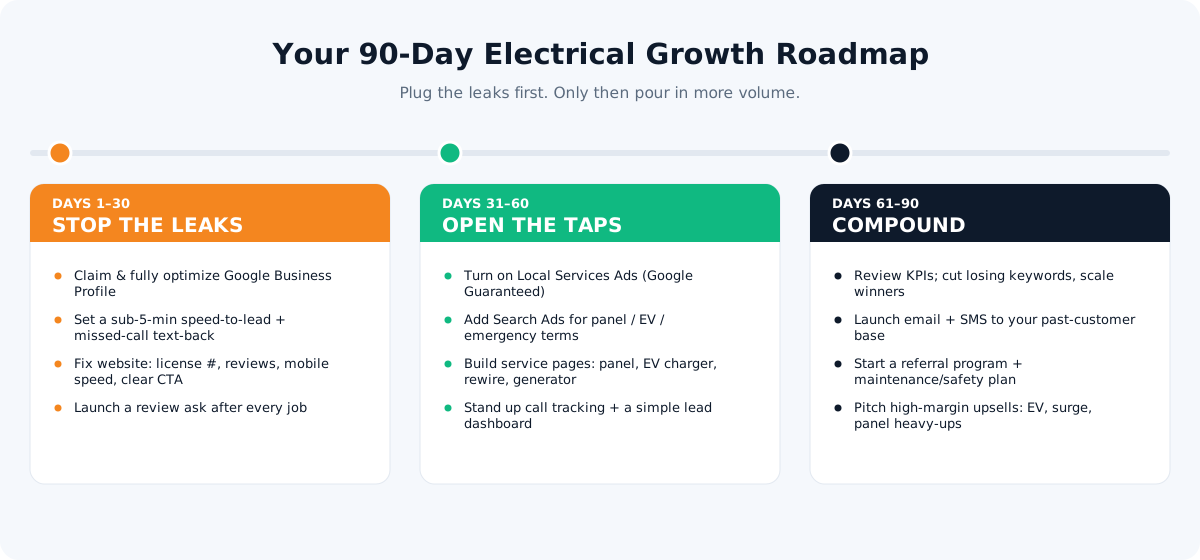
Days 1–30 — Stop the leaks.
- Claim and fully optimize your Google Business Profile (every field, ten-plus real photos, license number, weekly posts).
- Set up speed-to-lead: instant form auto-responses and a missed-call text-back, with a goal of responding in under five minutes.
- Audit and fix the website — license and badges visible, fast on mobile, click-to-call everywhere, short forms, dedicated pages for your top services.
- Launch a review request after every completed job.
None of this requires an ad budget; it just stops you from wasting the demand you already have.
Days 31–60 — Open the taps.
Now that the funnel holds water, add volume.
- Turn on Local Services Ads (complete verification for the Google Guaranteed badge) — for most electricians, this is the highest-ROI channel and the right first paid move.
- Layer in Google Search Ads on high-intent terms (panel upgrades, EV chargers, emergencies) with tight negatives and call tracking.
- Build out service pages for your high-margin work.
- Stand up call tracking and a simple lead dashboard so every channel is measured from day one.
Days 61–90 — Compound.
With data flowing, optimize and expand.
- Review your KPIs weekly: cut losing keywords, scale winners, fix the biggest funnel gap.
- Launch email and SMS to your past-customer base — seasonal reminders, maintenance prompts, win-backs.
- Start a referral program and a maintenance/safety plan to build recurring revenue.
- And lean into expansion: pitch the high-margin upsells (EV readiness, surge protection, panel heavy-ups) at every service call. This is where the flywheel starts turning on its own.
Run this sequence, and you’ll have a complete, measured growth system in a quarter — one that captures demand, converts it fast, retains customers, and grows their value over time.
Where to start
If this feels like a lot, remember the core idea: you almost certainly don’t have a lead-volume problem. You have a lead-leakage problem.
The demand for licensed electrical work is booming and getting stronger every year.
The contractors who win in 2026 aren’t the ones who pour in the most leads — they’re the ones whose systems leak the least and whose customers are worth the most.
Pick the biggest leak you have right now — an unanswered phone, an invisible map listing, a website that converts almost no one, a past-customer list you never email — and plug it this week.
Then move to the next. Stop the leaks, open the taps, compound the value. That’s the whole system.
If you’d like to see exactly where your leads are leaking — and what it’s costing you in revenue — start with the Electrician Lead Leak Calculator.
It turns your own numbers into a clear picture of the money slipping through the gaps, and the specific fixes that recover it.

Find your leaks.
Run the free Electrician Lead Leak Calculator → or grab the Local Lead Checklist → to plug them one by one.