



Most plumbing owners think they have a lead-volume problem. They don’t. They have a lead-leak problem.
The phone does ring. The form does get filled out. Someone does search “emergency plumber near me” at 9:40 on a Tuesday night.
But somewhere between that first spark of demand and a paid invoice, the lead leaks out — through a slow callback, a missing Google listing, a website that loads like it’s 2012, or a customer who never hears from you again after one job. Every leak quietly drains revenue from the system.
This guide treats your marketing the way you’d treat a customer’s plumbing: as a system of pipes and joints where pressure (demand) either reaches the fixture (a booked job) or escapes through a gap.
The job isn’t to pump more water through a leaking system. It’s to find the leaks and plug them. Do that, and the leads you’re already generating start converting at a rate that makes your competitors wonder what you’re spending.
Below is the complete system — from industry context to local SEO, Google Ads, reviews, retention, automation, budgets, and a 12-month growth plan you can actually run.
In this guide
- The plumbing industry in 2026: a fragmented, recession-resistant market
- Building a plumbing marketing system (the leak framework)
- Local SEO for plumbers
- Google Maps and the Local Pack
- Your plumbing website
- Google Ads for plumbers
- Emergency plumbing lead generation
- Referral systems
- Review generation
- Social media marketing
- Email marketing
- Customer retention
- Membership and service plans
- Automation systems
- Growth metrics that matter
- Budgets and your 12-month growth plan
The plumbing industry in 2026: a fragmented, recession-resistant market
Before you spend a dollar on marketing, it helps to understand the field you’re playing in — because the structure of the plumbing industry is unusually friendly to a focused operator.
The U.S. plumbing industry is large and stable. IBISWorld pegs 2026 revenue at roughly $191.4 billion, growing at about a 3.1% annual rate over the past five years, spread across roughly 129,000 businesses that employ more than 735,000 people.
The average plumbing company generates around $1.48 million in annual revenue. Crucially, no single company holds more than about 5% of the market.
This is one of the most fragmented service sectors in the economy, which means local reputation and response speed — not national brand spend — decide who wins the job.
Demand is also remarkably durable. Industry analysts estimate that 70–80% of plumbing service calls are urgent — burst pipes, sewer backups, water heater failures, no-hot-water mornings.
That non-discretionary demand is why plumbing is considered recession-resistant: a homeowner can postpone a kitchen remodel, but not a flooded basement.
Layer on a median U.S. home age of 44 years and aging municipal infrastructure, and the structural demand is only growing.
The catch is on the supply side. The industry faces a well-documented skilled-labor shortage, with forecasts of a shortfall in the hundreds of thousands of plumbers.
For most established shops, the growth constraint is capacity, not customers.
That changes how you should think about marketing: the goal isn’t infinite lead volume, it’s qualified, high-margin leads that keep your best techs busy on the right jobs — and a system efficient enough that you’re not burning cash chasing leads you can’t service.
One last data point that should reframe how you view your own marketing: surveys consistently find that roughly 70% of plumbing companies working with a marketing agency are unhappy with the results.
That dissatisfaction isn’t usually about a lack of leads. It’s about leaks — money spent at the top of the funnel that never converts at the bottom. Which is exactly what this guide is built to fix.
Illustrative composite:
Throughout this guide, the “before/after” examples are illustrative composites built from common patterns across home-service trades, not case studies of specific named clients.
The numbers are realistic and grounded in current benchmarks, but treat them as models, not testimonials.
Building a plumbing marketing system (the leak framework)
Random acts of marketing — a boosted Facebook post here, a truck wrap there, a coupon mailer once a quarter — don’t compound. A system does.
The leak framework provides a single mental model for the entire customer journey, broken into four stages in which leads either flow through or escape.

Leak 1 — Visibility (they never find you). If you’re not in the Google Local Pack, not ranking for “[your city] plumber,” and invisible on the map, the lead is lost before it ever becomes a contact.
This is the attract stage: local SEO, Google Maps, Google Ads, and reviews.
Leak 2 — Speed and follow-up (they find you, but you’re slow). The lead calls or fills out a form, and then… nothing for 40 minutes. By then, they’ve called the next plumber.
This is the capture stage, and it’s the single most expensive leak in the trades (more on the data below).
Leak 3 — Conversion (they reach you but don’t book). A confusing website, no online booking, a quote that takes three days, and no proof you’re trustworthy.
This is the convert stage: website, reviews, and sales process.
Leak 4 — Retention (one job and gone). You did great work, then never spoke to them again — so when their water heater dies in two years, they Google a stranger.
This is the retain stage: email, membership plans, and follow-up automation.
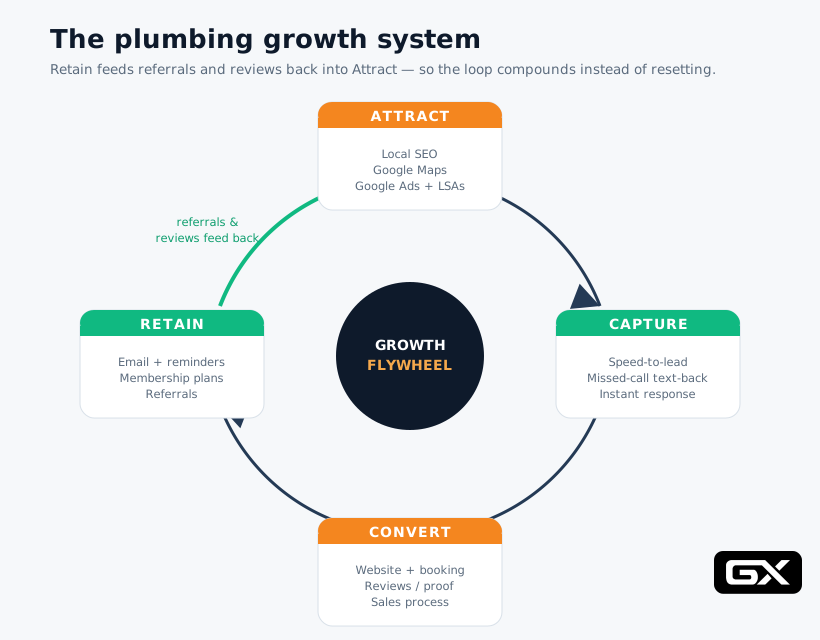
The rest of this guide walks through each stage in order. As you read, keep score: which leak is costing you the most right now?
That’s where your next dollar and next hour should go.
Local SEO for plumbers
Local SEO is how you stop paying for visibility you could own.
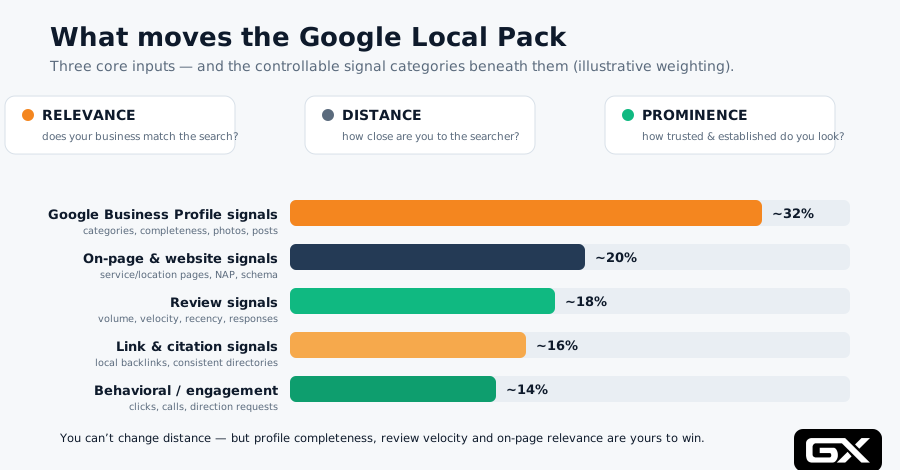
When someone searches “drain cleaning [city]” or “plumber near me,” Google assembles results based on three things:
- relevance → does your business match the search?
- distance → how close are you?
- prominence → how established and trusted do you look online?
You can’t move your trucks closer to every searcher, but you can dominate relevance and prominence.
Nail your foundation — NAP consistency.
Your business Name, Address, and Phone number must be identical everywhere they appear: your website, Google Business Profile, Yelp, Angi, BBB, and local directories.
Inconsistent NAP data is one of the most common, most fixable visibility leaks. Pick one canonical format and enforce it.
Build service pages, not a brochure. A single “Services” page is a missed opportunity.
Google rewards depth, so build a dedicated page for each core service: drain cleaning, water heater repair and installation, sewer line repair, leak detection, repiping, sump pumps, gas lines, and emergency service.
Each page should answer the questions a homeowner actually asks — typical cost ranges, warning signs, how long it takes, and what to do right now.
Build location pages if you serve multiple cities.
A page per service area (with genuinely localized content — neighborhoods served, local landmarks, area-specific issues like hard water or tree-root intrusion) helps you rank in towns where you don’t have an office.
Don’t spin up thin, near-duplicate pages, though; Google penalizes those.
Earn local relevance signals.
Reviews that mention specific services and cities, photos geo-tagged to your service area, and local backlinks (the chamber of commerce, a supplier’s “find a pro” page, a sponsored youth team) all tell Google you’re genuinely embedded in the community.
One stat to anchor the effort: roughly 46% of all Google searches have local intent, and the businesses that win local search aren’t the ones with the flashiest sites — they’re the ones with complete listings, a steady flow of fresh reviews, and pages built around what local homeowners search for.
Google Maps and the Local Pack
The Local Pack — the map plus three business listings that appear at the top of local searches — is the single most valuable piece of real estate in local search.
Data shows that appearing in the top three map results drives on the order of 126% more traffic and 93% more direct actions (calls, direction requests) than ranking in positions four through ten.
For an emergency-driven trade, the Local Pack is often where the job is won or lost.
Your Google Business Profile (GBP) is the engine. Optimize it relentlessly:
Fill in the business description, hours (including a clearly marked 24/7 emergency line if you offer one), and service areas.
Upload real job photos, your trucks, your team, and before/afters. Add fresh photos every week or two; recency is a signal.
Top-ranking plumbing businesses average well over 200 Google reviews. We cover the how in the review section below.
A note on AI search. Google’s AI Overviews now appear on the majority of searches and pull heavily from review content and structured business data.
Separately, a fast-growing share of consumers — by some 2026 surveys, close to half — now use tools like ChatGPT to find local providers.
A complete, review-rich, consistently-managed profile is increasingly what gets you cited in those AI answers, not just ranked in the blue links.
Your plumbing website
Your website is where the conversion leak lives. You can rank perfectly and run flawless ads, and still lose the job on a slow, confusing, trust-free page.
Treat the site as a conversion machine with one purpose: turn a visitor into a phone call or a booked appointment.
The non-negotiables:
- Speed. More than half of mobile visitors abandon a page that takes more than three seconds to load.
For an emergency trade, every second of load time is a leaking joint. Compress images, use a fast hosting provider, and keep the homepage lean.
- Mobile-first. The overwhelming majority of “plumber near me” searches happen on phones.
Your phone number should be a giant tap-to-call button visible without scrolling.
- Click-to-call above the fold. On every page, on every screen size.
The number-one job of a plumbing site is to make calling effortless.
- Trust signals immediately: star rating and review count, licensed/bonded/insured badges, years in business, service-area map, photos of real techs and trucks, and any guarantees (“upfront pricing,” “on-time or it’s free”).
- Online booking / instant quote. A growing share of customers — especially younger homeowners — would rather book a slot than make a call. Offer both.
- Service and location pages (from the local SEO section) that double as landing pages for ads.
- A clear, single primary action per page. Call now. Don’t dilute it with ten competing buttons.
Conversion math, illustrated. Suppose your site gets 1,000 visits a month and converts at 2% — that’s 20 leads.
Tighten load speed, add click-to-call and visible reviews, and lift conversion to 4%, and you now get 40 leads from the same traffic.
You didn’t pay for a single extra visitor. You just stopped the leak.
At a typical plumbing average ticket of $1,680, those 20 extra leads — even at a modest close rate — are the difference between a slow month and a strong one.
Google Ads for plumbers
Local SEO and Maps compound over months. Google Ads turns on demand today — which is why most growing plumbing companies run both: paid for immediate cash flow, organic for long-term efficiency that lowers your cost per job over time.
Plumbing is one of the most competitive categories on Google Ads, and you should know that going in.
National lead-gen platforms like Angi and Thumbtack bid aggressively on the same emergency keywords, which raises the floor for everyone.
Cost-per-click for plumbing terms typically runs in the $6–$11 range at the midpoint, with high-urgency emergency keywords (“burst pipe,” “emergency plumber”) often exceeding $30–$50 a click.
Here’s the benchmark data that should frame your strategy. SearchLight’s 2026 analysis of $14.6 million in non-branded plumbing ad spend across 524 contractors found:
- Non-branded search: ~$183 per lead (true new-customer acquisition).
- Performance Max: ~$82 per lead — roughly 55% cheaper, though typically with a lower book rate.
- Branded search: ~$34 per lead — defending your own name from competitors bidding on it.
- By service line: general plumbing ~$161, drain/sewer ~$166, water heater ~$256 (higher competition, higher ticket).
- The median contractor spent about $5,055/month on non-branded search, converted 18.4% of leads into paying customers at a ~$333 cost per customer, on a ~$1,680 average ticket — producing roughly a 5.5x return on ad spend.
How to keep your cost per lead profitable:
- Segment campaigns by service line. Separate “drain cleaning,” “water heater,” and “emergency repair” instead of one generic “plumbing” campaign.
Tighter intent matching typically cuts cost per lead by 15–25%.
- Run a small branded campaign. It’s cheap insurance against competitors poaching searches for your own name, and it pulls down your blended cost per lead.
- Guard your spend with negative keywords. Block “DIY,” “how to,” “salary,” “parts,” “supply store,” and job-seeker terms.
Broad match without aggressive negatives is where budgets quietly bleed.
- Tight geo-targeting. Limit to the ZIP codes and radius you actually serve.
Paying for clicks you can’t dispatch to is a pure leak.
- Send ads to a dedicated landing page, never the homepage. One service, one offer, one giant call button.
- Feed conversions back to Google. Tracking which leads become paying customers (not just clicks) lets Google’s bidding optimize toward revenue, and lead quality improves over time.
Don’t overlook Local Services Ads (LSAs). Google’s pay-per-lead LSAs sit above regular search ads with a “Google Guaranteed” badge — a powerful trust signal for nervous homeowners.
You pay per qualified lead (commonly in the ~$6–$90 range for home services) rather than per click, and the badge meaningfully lifts conversion.
For most residential plumbers, LSAs belong in the mix alongside search.
Emergency plumbing lead generation (the most expensive leak)
If you remember one section of this guide, make it this one.
Emergency response speed is the highest-leverage, lowest-cost lever you have — and almost nobody pulls it.
The research is brutal and consistent. Studies from MIT and Harvard Business Review found that responding to a new lead within five minutes makes you up to 21 times more likely to qualify it than waiting 30 minutes, and dramatically more likely to even make contact.
Roughly 78% of customers buy from the first business that responds. Lead quality drops by about 80% after the first five minutes.
Now the part that should excite you: only about 0.1% of field-service businesses actually respond within five minutes.
The industry average response time is measured in tens of hours.
On top of that, call-intelligence research found that about 27% of calls to contractors go unanswered entirely, and 85% of callers who reach voicemail never leave a message or call back.
Every one of those is a paid-for lead leaking straight out of the bottom of the pipe.

How to win the emergency lead:
- Answer live, 24/7. If you can’t staff it, use a professional answering service or an AI receptionist that books appointments — the ROI is enormous when a single captured after-hours burst-pipe call is worth thousands.
- Missed-call text-back. The instant a call goes unanswered, an automated text fires: “Sorry we missed you — this is [Company]. Reply here, and we’ll get a tech to you fast.”
This single automation recovers a stunning share of the 85% who otherwise vanish.
- Instant form response. When someone fills out a form, trigger an immediate text and a callback within minutes — not “within 24 hours.”
- Persist. Research shows it takes around eight touchpoints on average to convert a lead, yet the typical rep gives up after barely one attempt.
Build a 6–8 touch follow-up sequence across call, text, and email over the first 48 hours.
- The first real conversation wins. In multi-bid situations, the contractor who has the first genuine conversation books 35–50% of the jobs.
Illustrative composite: A two-truck shop spends $4,000/month on ads, generating ~30 leads but answers only about two-thirds of calls and follows up the next day.
Closing maybe 18% means roughly 5 jobs.
Add live 24/7 answering plus missed-call text-back and a 6-touch sequence, push answered-and-followed-up rate toward 90%, and the same 30 leads can convert closer to 8–9 jobs.
No new ad spend — just a sealed joint worth thousands in monthly revenue.
Referral systems
Referrals are the highest-margin leads you will ever get: no ad cost, pre-built trust, and a close rate that makes paid leads look expensive.
Yet most plumbers leave them to chance — “people just refer us.” Turn it into a system.
- Ask at the moment of delight. Right after a tech finishes a job that the customer is visibly happy with is the highest-conversion moment to ask.
Train techs to say one simple line: “If you know anyone who needs a plumber, here’s a couple of cards — and we take great care of referrals.”
- Make the reward concrete and two-sided. “$25 off for you and $25 off for them” beats a vague “we appreciate referrals.”
Account credits, gift cards, or a discount on their next service all work. - Build a contractor and realtor referral network.
Home inspectors, real estate agents, property managers, remodelers, and HVAC companies all encounter plumbing needs constantly.
A simple reciprocal referral arrangement with a handful of these partners can become a steady, low-cost lead channel.
- Automate the ask. A post-job email or text (a few days later, once the work has proven itself) with a one-tap referral link removes the friction of remembering.
A referral program costs almost nothing to run and feeds the very top of your growth loop — referred customers also tend to spend more and refer others, compounding the effect.
Review generation
Reviews are where reputation and ranking meet.
They influence whether Google shows you (a ranking factor), whether AI tools recommend you, and whether a homeowner clicks you over the competitor right next to you.
The numbers make the case. 97% of consumers read reviews before choosing a local business.
A rising share — by 2026 surveys, around a third — won’t consider a business under 4.5 stars, and roughly 57% won’t use one below 4.0 stars.
Businesses with 50+ reviews generate dramatically more leads than those with under 10.
And recency is now decisive: about 73% of consumers only weigh reviews written in the last month, so a pile of three-year-old five-stars won’t save you.
The practical target is at least one new review per week to keep both customers and the algorithm convinced you’re active.
A review generation system that actually runs:
- Automate the ask after every completed job. Trigger a text and/or email within a day or two: a short, friendly message with a direct link to your Google review page (a link, not “search for us”). SMS requests get the highest response.
- Make it one tap. Every extra step is a leak. QR codes on invoices and trucks, a link in the job-completion text, a tablet the tech hands over on-site.
- Use neutral phrasing. “Would you share your experience on Google?” — not “leave us 5 stars.”
Buying or gaming reviews now carries real FTC penalties; keep it clean.
- Respond to every review — good and bad. Responding is itself a ranking and trust signal; businesses that reply to a meaningful share of reviews see materially better lead and revenue numbers.
For negative reviews, respond promptly, professionally, and with a path to resolution.
Handled well, a negative review plus a great response can build more trust than a wall of perfect fives.
- Aim past your market’s bar. Top-ranking plumbing businesses often carry 200+ reviews at a 4.7–4.9 average.
You don’t need that on day one — you need consistent velocity that gets you there.
Social media marketing
Social media won’t usually catch the 9:40 PM burst-pipe emergency — that’s a search-and-speed game.
What it does is build the prominence, trust, and top-of-mind awareness that make every other channel convert better, and it captures planned, higher-ticket work (repipes, water heaters, bathroom remodels) where homeowners research before they buy.
Where to focus, by platform:
- Facebook is still the workhorse for residential plumbers: local community groups, neighborhood “recommend a plumber” threads, before/after job posts, and prospecting ads to homeowners in your service area.
Many plumbers find local Facebook groups a genuine lead channel.
- Instagram rewards visual proof — clean installs, satisfying drain-clearing clips, team culture.
- TikTok, Reels, and YouTube Shorts are where short-form organic reach lives now.
“Satisfying” plumbing content (a camera down a clogged line, a perfect copper sweat joint, a hydro-jet in action) travels surprisingly far and humanizes your brand for almost no cost.
- YouTube (long-form) builds genuine authority: “how to tell if your water heater is failing,” “what a sewer scope actually shows.”
This content also feeds your SEO and gives techs something to send nervous customers.
- LinkedIn matters mainly for commercial plumbing and for retargeting / account-based outreach to property managers and facilities decision-makers.
Keep it sustainable. Don’t try to be everywhere.
Pick one or two platforms, post consistently (a couple of times a week beats a daily burst that burns out), and repurpose: one job site visit can yield a Reel, a Facebook post, a YouTube Short, and three photos for your GBP.
The point of social isn’t virality — it’s being the familiar, trusted name when the planned job finally lands.
Email marketing
Email is the most underused tool in the trades, and it’s the cheapest way to plug the retention leak.
Every customer you’ve ever served is a future job and a future referral — if you stay in their inbox.
What to send:
- Welcome / first-job follow-up: thank them, recap the work, set expectations, and link to your review page.
- Seasonal maintenance reminders: “Winterize before the first freeze,” “Flush your water heater this spring,” “Pre-summer sewer check.”
These are gold — they’re genuinely helpful and they generate booked work in your slower weeks.
- Membership / service-plan offers (see next section).
- A simple monthly or quarterly newsletter: a maintenance tip, a seasonal heads-up, a small promotion. Low effort, high familiarity.
- Win-back campaigns: customers you haven’t seen in 12–18 months get a targeted “we miss you” offer.
Make it automated, not manual. The win is in sequences that fire on their own — a new customer automatically enters the welcome series; an anniversary of a water-heater install automatically triggers a “your unit is getting older, here’s what to watch for” email.
Built once, it runs forever. We cover the plumbing for this in the automation section.
A realistic frame: an email list of even 1,500 past customers, nudged with two good seasonal campaigns a year, can reliably resurface dozens of jobs annually at effectively zero marginal cost — pure recovered leakage.
Customer retention
Acquiring a new customer through paid ads can cost a few hundred dollars in fully-loaded acquisition cost.
Keeping an existing one costs a fraction of that — and existing customers spend more, close faster, and refer more.
Retention isn’t a “nice to have”; it’s the cheapest growth you have access to.
The retention leak is subtle because it doesn’t show up as a missed call — it shows up as a customer who would have called you but didn’t think of you.
Plug it with deliberate post-job touchpoints:
- A genuine thank-you and a clear “who to call next time.”
Leave a branded fridge magnet, a sticker on the water heater with your number and the install date, and a follow-up message.
- Proactive maintenance outreach (via email/text automation) so you’re the one reminding them their water heater is aging — before it fails on a competitor’s watch.
- A loyalty or membership plan that makes staying with you the default (next section).
- Track and measure it. Watch repeat-customer rate and customer lifetime value as core metrics, not afterthoughts.
A modest lift in repeat rate compounds enormously over a few years.
Illustrative composite: Two identical shops each serve 600 new customers a year.
Shop A never follows up; about 15% ever call again. Shop B runs maintenance reminders, a membership plan, and a newsletter, and lifts repeat rate to 35%.
Within three years, Shop B is generating more revenue from the same acquisition spend — meaningfully — with the entire difference due to sealed retention leakage.
Membership and service plans
A membership plan is the single best retention-and-cash-flow tool in plumbing.
For a flat annual or monthly fee, the customer gets an annual inspection, priority emergency scheduling, a discount on repairs (say 10–15%), no overtime/after-hours fees, and maybe a water-heater flush.
In return, you get three things that transform a plumbing business:
Designing the plan:
- Keep the tiers simple — often one or two is enough (“Home Protection Plan”).
- Price it so the perceived value clearly exceeds the cost (the annual inspection, priority, and discount should feel like a no-brainer).
- Make joining frictionless and offer it on every job: the moment after a repair is the ideal time for a tech to say, “By the way, members get priority and 15% off — want me to set that up?”
- Bill it monthly if you can; recurring monthly billing improves retention and cash flow.
- Track membership count as a core growth metric — it’s one of the most reliable predictors of a stable, valuable plumbing business.
Automation systems
Every leak we’ve discussed is plugged most reliably by automation, because automation doesn’t get busy, forget, or go home at 5 PM.
This is the connective plumbing that ties the whole system together — and “disconnected systems” is itself one of the biggest sources of leakage.
The hub is a CRM/field-service platform (a category that includes tools like Housecall Pro, ServiceTitan, Jobber, and similar) that connects your lead intake, dispatch, customer database, and follow-up.
Once that’s in place, the high-ROI automations to turn on, roughly in priority order:
- Missed-call text-back — recovers the 85% of voicemail-hitters who’d otherwise vanish. Highest ROI, set up first.
- Instant lead response — auto-text and auto-task on every form fill so a human follows up within minutes.
- Review request sequence — fires automatically after job completion.
- Appointment reminders — cut no-shows with automated text confirmations.
- Maintenance / seasonal reminders — scheduled email/text campaigns to past customers.
- Membership renewal and billing — automated so recurring revenue doesn’t depend on someone remembering to invoice.
- Win-back sequences — automatically re-engage customers gone quiet for 12–18 months.
The principle: map your customer journey once, identify every point where a human currently has to remember to do something, and replace that human-memory dependency with an automated trigger.
Humans are for the high-value conversations (closing the job, the on-site experience).Software is for the follow-up that humans reliably forget.
That division of labor is what lets a small shop respond like a big one.
Growth metrics that matter
You can’t plug a leak you can’t see. Most plumbing owners track revenue and maybe ad spend, and nothing in between — which means they can’t tell which joint is leaking.
Track the funnel end-to-end.
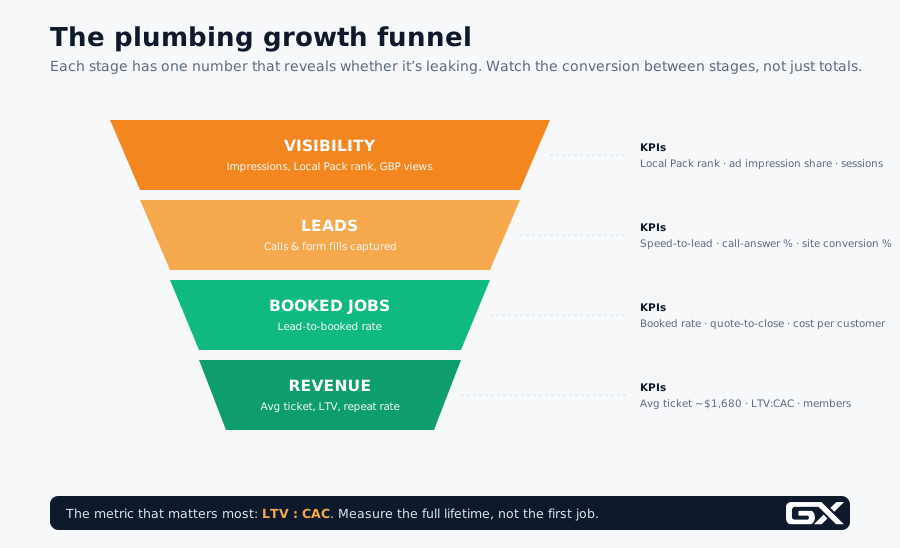
The core metrics, by stage:
- Visibility: Local Pack rankings for your key terms, GBP views, website sessions, ad impression share.
- Capture / speed-to-lead: average response time, call-answer rate, missed-call recovery rate. (If you measure one new thing this quarter, measure this.)
- Conversion: website conversion rate, lead-to-booked-job rate (book rate), quote-to-close rate.
- Economics: cost per lead and cost per acquired customer by channel, average ticket, and return on ad spend (ROAS).
Benchmark against the figures earlier — e.g., median plumbing CAC around $333 and ROAS around 5.5x.
- Retention / lifetime: repeat-customer rate, customer lifetime value (LTV), membership count, review count, and velocity, referral count.
The most important relationship is LTV-to-CAC.
If a customer is worth, say, $4,000 over their lifetime (multiple jobs + membership + referrals) and costs you $350 to acquire, that’s a ratio you can pour fuel on.
Owners who only look at the first-job economics — “this led to a cost of $183, and the job was only $250” — talk themselves out of profitable marketing because they’re measuring the wrong thing.
Measure the full lifetime, and the math usually flips from “too expensive” to “spend more.”
Pick 5–7 of these, put them on a simple dashboard, and review them monthly. The act of measuring is itself a leak-finder.
Budgets and your 12-month growth plan
There’s no universal “right” budget, but a useful rule of thumb for service businesses pursuing growth is to invest roughly 5–10% of revenue in marketing (higher if you’re aggressively scaling, lower if you’re capacity-constrained).
More important than the percentage is where it goes — and the allocation should follow the leaks.
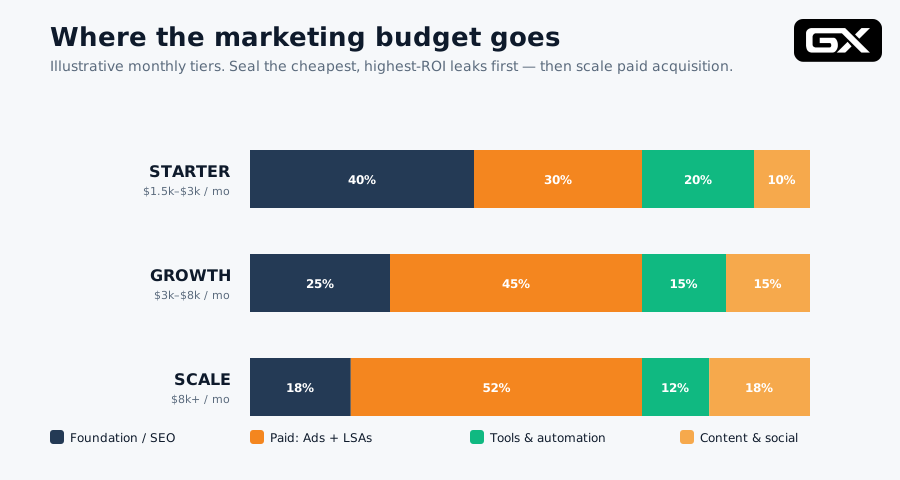
Illustrative monthly tiers (adjust to your market and capacity):
- Starter (~$1,500–$3,000/mo): Fix the foundation first. GBP optimization, NAP cleanup, basic website conversion fixes, review automation, and missed-call text-back.
A small, tightly-targeted Google Ads or LSA budget on your highest-intent emergency terms. Goal: stop the cheapest leaks before buying more leads.
- Growth (~$3,000–$8,000/mo): Scale Google Ads + LSAs across segmented service lines, expand local SEO (service + location pages, link building), commit to consistent content/social, and add full automation (CRM sequences, membership program launch).
- Scale ($8,000+/mo): Multi-city expansion, larger paid budgets with conversion-feedback bidding, dedicated content/video production, ABM for commercial work, and ongoing CRO on the website.
At this tier, you’re optimizing a working machine, not searching for one.
Your 12-month growth plan

Phase 1 — Seal the foundation (Months 0–2).
- Claim and fully optimize your Google Business Profile.
- Fix NAP consistency everywhere.
- Run a website conversion audit (speed, click-to-call, trust signals).
- Turn on missed-call text-back and an instant-lead-response automation.
- Launch a review-request sequence.
This phase plugs the visibility and speed leaks for almost no money and usually produces the fastest results.
Phase 2 — Capture and convert (Months 2–5).
- Stand up Local Services Ads and a small, segmented Google Ads campaign on emergency terms.
- Build out core service pages.
- Implement a 6–8 touch lead follow-up sequence.
- Get review velocity to one-plus per week.
- Train techs on the referral ask.
Now you’re converting the demand you’re capturing.
Phase 3 — Scale acquisition (Months 5–8).
- Expand paid budgets with conversion-feedback bidding once your funnel converts reliably.
- Add location pages for new service areas.
- Commit to a sustainable social/content cadence (Reels + GBP photos from job sites).
- Launch your membership plan.
Open the lead valve wider — safely, because the pipe is sealed.
Phase 4 — Retain and compound (Months 8–12).
- Roll out seasonal email/text campaigns and win-back sequences.
- Push membership enrollment on every job.
- Formalize realtor/contractor referral partnerships.
- Build the metrics dashboard and review LTV:CAC monthly.
This phase turns one-time jobs into a compounding loop of repeat work, reviews, and referrals — the flywheel from Figure 2.
The bottom line
You almost certainly don’t need more leads; you need to stop losing the ones you have.
The plumbing market is large, fragmented, and demand-rich; the businesses that win it aren’t the ones spending the most — they’re the ones with the fewest leaks.
Seal visibility, speed, conversion, and retention in that order, automate the joints so nothing depends on memory, and measure the whole pipe end to end.
Start with the one leak costing you the most this month. Plug it. Then the next. That’s the entire game.
Ready to find your biggest leak?
Run the numbers on the Plumbing Lead Leak Calculator and grab the Plumbing Local Lead Checklist to put this guide into action this week.