
If you own an HVAC company, you already know the hard truth: the phone doesn’t ring on its own anymore.
When a homeowner’s air conditioner quits at 2 p.m. on the hottest day of July, they don’t flip through a phone book or ask a neighbor.
They grab their phone, type “AC repair near me,” and call the first name they see. If your business isn’t on that short list, the job goes to whoever is — usually the company down the street with a better online presence, not a better crew.
That’s the reality HVAC marketing has to solve in 2026. Search behavior has shifted, Google keeps changing how local results work, and AI-powered answers are now part of the buying journey.
The good news is that none of this requires a huge budget or a marketing degree. It requires a system.
This guide walks you through that system, step by step. We’ll cover your website, Google Business Profile, local SEO, the new world of AI search, paid ads, reviews, and — most importantly — the follow-up process that turns clicks into booked jobs.
Everything here applies to HVAC first, but the same playbook works for plumbing, roofing, and electrical contractors too.
What Is HVAC Marketing?
HVAC marketing is everything you do to get found by homeowners and property managers when they need heating and cooling services — and to convince them to choose you over a competitor.
It combines your website, local search visibility, online reviews, paid ads, and the systems you use to respond to and follow up with every lead.
When done well, it does three things: it makes you visible at the exact moment someone needs help, it builds enough trust that they pick up the phone, and it ensures no lead slips through the cracks once they do.
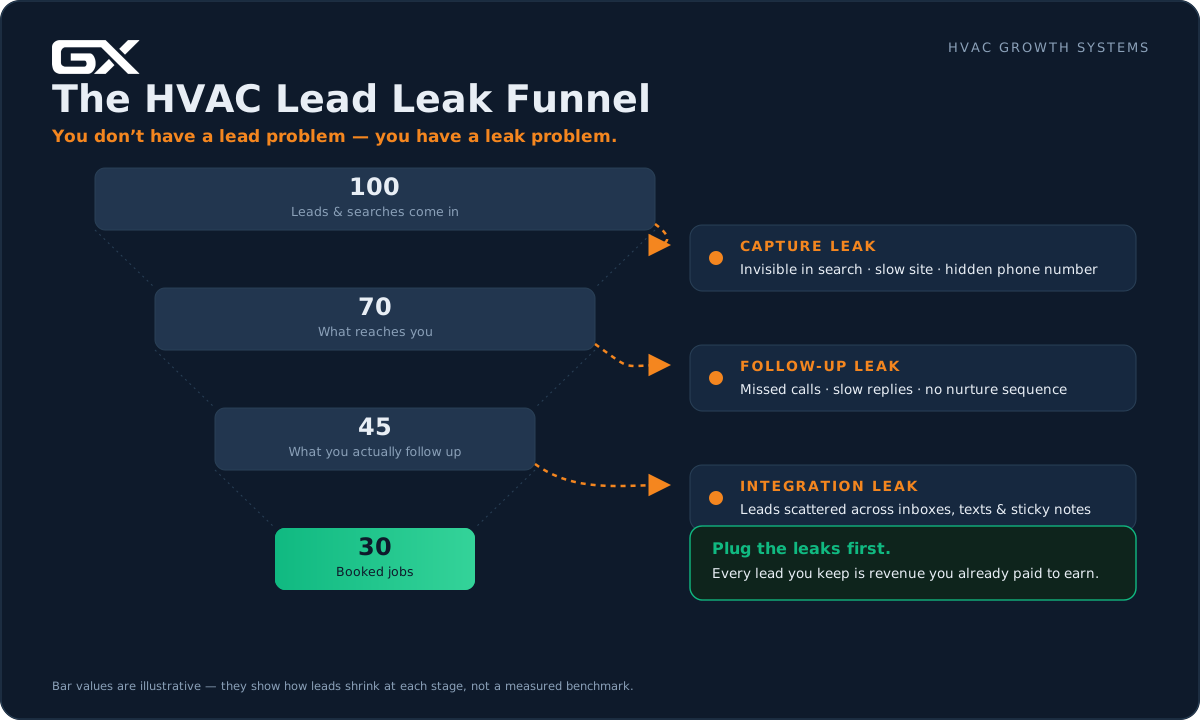
The Real Problem: You Don’t Have a Lead Problem, You Have a Leak Problem
Most HVAC owners think they need *more* leads. They pour money into ads, chase a new tactic every few months, and still feel like growth is stuck.
Here’s what usually happens instead: leads come in, but they leak out before they turn into jobs. A call goes to voicemail during a busy install.
A web form sits unanswered for six hours. A quote gets sent and never followed up on. A five-star customer is never asked for a review.
We call this the leak problem, and it shows up in three places:
- Capture leaks — you’re invisible in search, your site loads slowly, or your contact info is hard to find, so the lead never reaches you.
- Follow-up leaks — the lead reaches you, but nobody responds fast enough (or at all), so they call the next company.
- Integration leaks — leads land scattered in inboxes, texts, and sticky notes instead of one system, so they get forgotten.
Marketing that focuses only on generating more leads while ignoring these leaks is like pouring more water into a bucket with holes. Throughout this guide, we’ll fix both sides: getting found *and* plugging the leaks.
The 2026 HVAC Search Landscape (What Changed)
Before the tactics, it helps to understand a few things that make HVAC marketing different — and what’s new this year.
HVAC demand is seasonal and spiky. Searches for cooling can climb sharply from spring into early summer, then heating searches spike again in fall.
Your content and ad spend should follow those curves rather than fight them.
Emergency intent dominates. A large share of HVAC searches are urgent. People searching “furnace not working” aren’t comparison shopping — they’re calling the first credible option. Speed and visibility win those jobs.
Each job is worth a lot. A single system installation commonly runs several thousand dollars.
That high value changes the math on marketing: even a modest number of extra booked jobs a month can pay for a serious marketing program.
Search itself is changing. Alongside the classic list of blue links, homeowners now see AI-generated answers (Google’s AI Overviews) and increasingly ask tools like ChatGPT and Perplexity for recommendations.
Your business needs to be visible in those answers, not just on page one. We’ll cover how below.
The mobile angle matters too. Industry data consistently shows that most local service searches occur on phones, and Google reports that a strong majority of people who run a “near me” search on their smartphone visit a related business within 24 hours.
If your site is slow or hard to use on a phone, you’re leaking those high-intent visitors.
Strategy 1: Fix Your Website Foundation First
Your website is where every other marketing channel sends people. If it’s slow, confusing, or doesn’t build trust, everything upstream leaks.
Most HVAC websites are treated like a digital business card — a logo, a phone number, and a paragraph about “20 years of experience.” That’s not enough to rank or convert in 2026.
What a lead-generating HVAC website needs:
- Fast load times. Aim for a site that loads in a couple of seconds on mobile. Slow pages lose impatient, emergency-minded visitors.
- A phone number in the top-right corner on every page, tappable on mobile, plus a short quote form.
- Dedicated service pages — separate pages for AC repair, AC installation, furnace repair, heat pump installation, duct cleaning, and maintenance plans. A single “Services” page listing everything won’t rank for specific searches.
- Trust signals above the fold — license number, “Google Guaranteed” badge, review stars, years in business, and service-area map.
- Clear calls to action — “Call now,” “Book online,” or “Request a free quote” repeated throughout, not buried at the bottom.
Common mistake: hiding the phone number in the footer or making people scroll to find how to contact you. Every extra click is a leak.
Strategy 2: Own Your Google Business Profile and the Local Map Pack
If you do only one thing after reading this guide, optimize your Google Business Profile (GBP). It’s free, and it’s the single most powerful lever for local visibility.
Those top three map results that appear for “AC repair near me” — the local pack — are driven largely by your GBP, and they capture the majority of clicks.
How to optimize your GBP:
- Fill out every field. Google rewards complete profiles. Add your description, hours, service areas, attributes, and booking link. Leave nothing blank.
-
Set the right primary category. For most companies, that’s “HVAC contractor,” then add relevant secondary categories like “Air conditioning repair service,” “Furnace repair service,” and “Heating contractor.”
Categories decide which searches you’re even eligible to appear for, so don’t stop at one.
- List every city and town you serve. Homeowners search by their specific town, not by region.
- Post real job photos every month. Before-and-after shots of installs and repairs signal an active, legitimate business.
- Use GBP posts weekly to highlight seasonal offers, maintenance reminders, and 24/7 availability.
- Answer questions and respond to every review — more on reviews below.
Google has reported that businesses with complete, well-maintained profiles earn more consideration from searchers than those with incomplete listings. This is the highest-return hour you’ll spend all month.
Strategy 3: Build Local SEO That Compounds
Local SEO is the long game that makes your visibility durable. Unlike ads, it keeps working after you stop paying. For a deeper walkthrough, pair this section with our [local SEO guide for service businesses](/local-seo-guide-for-service-businesses/).
Three pillars work together:
1. On-page and content signals. Create individual service pages (above) and separate location pages for each city you serve — for example, “AC Repair in [City].”
Each page needs genuinely unique text: reference the local climate, common system types in that area, and neighborhoods. Never publish a template with only the city name swapped; Google spots that, and so do homeowners.
2. NAP consistency and citations. Your Name, Address, and Phone number must be identical everywhere they appear — your site, GBP, directories, and social profiles.
Inconsistent listings confuse Google and erode trust. Build citations on high-authority local directories and keep them accurate.
3. Authority signals (links and reviews). Earn backlinks from sources you already have relationships with — equipment manufacturers, local business associations, chambers of commerce, and community sponsorships.
A few relevant, local backlinks pointing at your most important pages often move the needle more than dozens of random directory links.
Content that earns rankings and trust:
- Seasonal maintenance checklists (“Fall furnace maintenance checklist for [region] homeowners”)
- Cost guides (“How much does a new AC unit cost in [city]?”)
- Comparison guides (“Heat pump vs. furnace: which is right for [state]?”)
- Local rebate and tax-credit guides for your state
- Emergency troubleshooting posts (“AC blowing warm air? Here’s what to check”)
Group related posts into clusters that all link to the matching service page. That signals topical authority and lifts the whole cluster.
Realistic timeline: GBP improvements can show up within a few weeks, but durable organic rankings usually take about 3 to 6 months to gain traction and 6 to 12 months to mature.
SEO compounds like interest — the contractor who stays consistent for a year wins.
Strategy 4: Get Found in AI Search (The 2026 Differentiator)
This is the biggest shift of the year. Homeowners increasingly get answers from Google’s AI Overviews and from AI assistants like ChatGPT and Perplexity, which summarize and recommend rather than just list links.
Optimizing for these is sometimes called GEO (generative engine optimization) or answer-engine optimization.
Our [AI guide for service businesses](/ai-guide-for-service-businesses/) goes deeper, but here’s the core checklist:
- Answer real homeowner questions as headings, then lead each answer with a clear, direct response of about 40–60 words before expanding.
- Use clean H1/H2 structure and short bullet lists so AI systems can easily extract your answers.
- Mention your city and service areas naturally throughout your content.
- Keep your NAP and GBP flawless — AI answers pull heavily from structured, consistent business data.
- Add structured data (schema) for your organization, services, FAQs, and reviews so machines understand your pages.
The businesses that show up in AI answers in 2026 are the ones with accurate profiles, strong reviews, clearly written pages, and clean, structured data.
If your fundamentals are solid, you’re already most of the way there.
Strategy 5: Use Paid Ads to Win Emergency Jobs Now
SEO builds momentum over months. Paid ads deliver visibility *today* — which is exactly what you want for emergency, high-intent searches. The two channels that matter most for HVAC:
Local Services Ads (LSA) and Google Guaranteed. These appear at the very top of many local searches with a “Google Guaranteed” badge, and you generally pay per qualified lead rather than per click.
The badge builds instant trust, and per-lead pricing means you’re paying for actual contacts, not curious clickers. For most HVAC contractors, LSA is the first paid dollar to spend.
Google Search Ads (PPC). Traditional pay-per-click ads let you target specific services and cities with tight control over messaging and budget. They’re excellent for filling gaps during slow seasons and for services LSA doesn’t cover.
Here’s how the three main channels compare so you can balance your budget:
| Channel | Speed to results | You pay for | Best for |
|---|---|---|---|
| Local SEO / GBP | Slow (3–12 months) | Time & content | Durable, lower-cost leads over time |
| Google Search Ads | Fast (days) | Clicks | Filling gaps, off-season, specific services |
| Local Services Ads | Fast (days) | Qualified leads | Emergency, high-intent jobs with trust badge |
Cost-per-lead figures vary widely by market and season, so treat any published averages as a starting reference and track your own numbers.
As a rule of thumb, industry reports tend to show Local Services Ads producing leads at a lower cost per lead than standard search ads, largely because you pay per lead and the Google Guaranteed badge lifts booking rates.
The right mix is usually all three, weighted toward SEO for the long term and paid ads for immediate flow. For a fuller treatment, see our [lead generation guide for service businesses](/lead-generation-guide-for-service-businesses/).
> A note on budget: the Air Conditioning Contractors of America (ACCA) has historically suggested contractors allocate roughly 10% of revenue to marketing, with a healthy share going to digital.
Use that as a sanity check, then let your own cost-per-booked-job data guide where the money goes.
Strategy 6: Turn Reviews Into Your Best Salesperson
Reviews influence rankings *and* the decision to call. For a homeowner comparing three companies in the map pack, star ratings and recent review count often decide the winner.
How to build reviews the right way:
- Ask every satisfied customer, ideally right after the job while satisfaction is high. Train techs to ask and follow up with an automated text containing a direct review link.
- Aim for steady velocity, not a one-time dump. A consistent flow of new reviews each month signals an active business and looks more trustworthy than a pile of reviews all posted the same week.
- Respond to every review, positive or negative. Thank happy customers by name; respond to criticism calmly and professionally. Prospects read your responses as closely as the reviews.
Common mistake: buying reviews or gating them (only asking happy customers to post publicly). This violates platform policies and erodes trust. Earn them honestly.
Strategy 7: Plug the Leaks With Speed-to-Lead and Automation
This is where most HVAC companies lose the most money — and where the biggest, fastest wins hide. All the visibility in the world is wasted if leads leak out after they arrive.
Speed-to-lead is everything. The company that responds first usually wins the job. When a form comes in, or a call is missed, minutes matter. Set up:
- Missed-call text-back — if a call goes unanswered, an automatic text fires within seconds: “Sorry we missed you! This is [Company]. How can we help?” This single automation recovers jobs that would otherwise leak straight to a competitor.
- Instant form-fill response — every web lead gets an immediate text or call, not a “we’ll get back to you” email hours later.
Put every lead in one system. Scattered leads across voicemail, email, texts, and Facebook messages guarantee some get forgotten.
A simple CRM captures every lead in one place, assigns follow-ups, and tracks whether they are booked or lost. This closes the integration leak.
Automate the nurture. Not every lead books on day one. Automated follow-up sequences — a few well-timed texts and emails over the next week — recover quotes that would otherwise go cold.
The same automation sends maintenance reminders that turn one-time customers into repeat revenue.
Our [business automation guide](/ultimate-business-automation-guide-for-service-businesses/) and [conversion optimization guide](/conversion-rate-optimization-guide-for-service-businesses/) go deep on building these systems.
The payoff is real: for most contractors, tightening follow-up delivers more new jobs per month than any amount of extra ad spend, because you’re finally keeping the leads you already paid to generate.
Strategy 8: Market With the Seasons, Not Against Them
Because HVAC demand swings with the weather, timing your marketing is a strategy in itself.
- Late winter → spring: Start optimizing and publishing AC content in February and March so you rank when cooling searches climb in April and May. Ramp AC-focused ads before the first heat wave.
- Summer: Lean into emergency AC repair. Emphasize same-day service and 24/7 availability in GBP posts and ads.
- Late summer → fall: Shift to heating. Publish furnace and heat pump content in August so it ranks before the first cold snap.
- Winter: Push emergency heating and maintenance plans; promote indoor-air-quality services during the season people spend indoors.
- Year-round: Keep maintenance-plan promotions and emergency pages live in every season. Membership plans smooth out revenue and build a base of repeat customers.
Common mistake: starting your seasonal campaign the week demand peaks. By then, it’s too late to rank. Prepare content and ads 6–8 weeks ahead of each season.
Strategy 9: Measure What Actually Matters
If you can’t measure it, you can’t grow it. Skip vanity metrics like raw impressions and track what connects to revenue:
- Cost per booked job (not just cost per lead)
- Lead-to-booked-job conversion rate — this exposes follow-up leaks
- Phone calls and form fills from each channel (use call tracking)
- Map pack rankings for your top service + city keywords
- Review count and average rating over time
- Speed-to-lead — how fast your first response goes out
Review these monthly. When cost per booked job drops and your conversion rate climbs, you know the system is working.
Your 30-60-90 Day Implementation Roadmap
Trying to do everything at once leads to doing nothing. Here’s the order that delivers the fastest wins:
Days 1–30 — Foundation and quick wins
- Fully optimize your Google Business Profile (categories, service areas, photos, description).
- Set up missed-call text-back and instant form response. (Biggest fast ROI.)
- Fix the obvious website leaks: mobile speed, visible phone number, clear CTAs.
- Launch a simple review-request process for every completed job.
Days 31–60 — Visibility and paid flow
- Build out dedicated service pages and your top location pages.
- Launch Local Services Ads (get Google Guaranteed) and a small Search Ads test.
- Ensure NAP is consistent across your main directories.
- Add FAQ and organization schema to key pages.
Days 61–90 — Momentum and optimization
- Start publishing seasonal, local content on a steady schedule.
- Build a handful of relevant local backlinks.
- Set up your CRM and an automated nurture sequence.
- Establish your monthly reporting on cost per booked job and conversion rate.
By day 90, you’ll have a complete, connected system — not a pile of disconnected tactics.
Common HVAC Marketing Mistakes to Avoid
- Chasing more leads while ignoring follow-up. Fix the leaks first.
- A slow, phone-number-hidden website. Every second and every extra click loses emergency callers.
- One generic services page instead of dedicated service and location pages.
- Only one GBP category. You’re invisible for everything you don’t list.
- Starting seasonal campaigns too late. Prepare weeks ahead of demand.
- Dumping reviews all at once instead of building steady velocity.
- Buying or gating reviews. It backfires and risks penalties.
- No tracking. If you don’t know your cost per booked job, you’re guessing.
Expert Tips From the Field
- Answer the phone like it’s the only lead you’ll get today. In emergency HVAC, the first credible answer usually wins the job.
- Photos beat adjectives. Real before-and-after job photos build more trust than any tagline — and they feed your GBP and website.
- Turn every job into three assets: a review request, a photo for your profile, and a maintenance-plan offer.
- Own your data. Directories like Angi and HomeAdvisor rent you leads; your own GBP, website, and reviews are assets you keep forever.
- Write for humans and machines. Clear, well-structured, locally specific pages rank in classic search *and* get pulled into AI answers.
Frequently Asked Questions
How much should an HVAC company spend on marketing?
A common benchmark, referenced by industry groups such as ACCA, is around 10% of revenue, with a large share allocated to digital channels. New or aggressively growing companies often invest more. The better guide than any percentage is your own numbers: track cost per booked job and invest where it’s lowest.
How long does HVAC SEO take to work?
Google Business Profile improvements can show results within a few weeks. Broader organic rankings typically start gaining traction in 3–6 months and mature over 6–12 months of consistent effort. SEO compounds, so early patience pays off later.
What’s the single most important HVAC marketing tactic?
For visibility, it’s optimizing your Google Business Profile to win the local map pack. For profit, it’s speed-to-lead — responding to every lead within minutes.
Most contractors get the fastest ROI by fixing follow-up first, then building visibility.
Are Local Services Ads worth it for HVAC contractors?
For most, yes. LSAs place you at the top with a Google Guaranteed badge and charge per qualified lead rather than per click, which tends to produce a lower effective cost per lead and strong booking rates.
They pair well with SEO, which builds durable visibility over time.
Do I need to worry about AI search in 2026?
Yes, but you don’t need a separate strategy. AI answers pull from the same fundamentals: accurate profiles, strong reviews, clearly written pages, and structured data.
Get those right, and you’ll show up in AI Overviews and assistant recommendations as a natural byproduct.
Should I market for all seasons or just my peak?
Both. Time your heaviest campaigns to lead each season by 6–8 weeks, but keep emergency-service and maintenance-plan marketing live year-round to smooth out demand and build repeat revenue.
Why am I getting leads but not booking jobs?
That’s almost always a follow-up (or integration) leak, not a lead-volume problem. Check how fast you respond, whether missed calls get a text back, and whether leads live in one system.
Tightening these usually lifts booked jobs faster than buying more leads.
Does this work for plumbing, roofing, and electrical too?
Yes. The channels and systems — GBP, local SEO, AI search, paid ads, reviews, and follow-up automation — are the same across home-service trades. Only the keywords, seasonality, and job specifics change.
Conclusion: Build the System, Keep the Leads
HVAC marketing in 2026 isn’t about a single magic tactic. It’s about building a connected system that gets you found at the moment homeowners need you, earns their trust, and — just as importantly — keeps every lead from leaking out before it becomes a booked job.
Start with the fundamentals: a fast website, an optimized Google Business Profile, and instant follow-up on every lead. Layer in local SEO, AI-search readiness, paid ads for emergency intent, and steady reviews.
Time it all with the seasons, measure what matters, and stay consistent. Do that, and your phone stops depending on luck and starts depending on a machine you built.
The contractors who win their markets this year aren’t the ones with the biggest budgets. They’re the ones with the tightest systems.
Ready to Stop the Leaks and Book More Jobs?
You don’t have to build all of this alone. GroXpertise designs complete growth systems for HVAC, plumbing, roofing, and electrical companies — websites, local SEO, Google Ads and Local Services Ads, review generation, CRM, and the follow-up automation that plugs your leaks.
First, find out where your leads are leaking. Use our free [HVAC Lead Leak Calculator](/lp/hvac-lead-leak-calculator/) to see how many jobs your business may be losing each month at capture, follow-up, and integration — and what that’s worth in revenue.
Then [book a free HVAC Growth Strategy Session](/home-service-marketing-agency/). We’ll review your current marketing, pinpoint your biggest leaks, and map out a plan to fix them — no pressure, no jargon, just a clear path to more booked jobs.
Your competitors are already showing up when the phone rings. Let’s make sure you’re the one who answers first.